July 11, 2026 • Margot Vellacourt • 10 min reading time • Prices verified June 4, 2026
AI Camera Litter Boxes: Do They Actually Catch Health Problems Early?
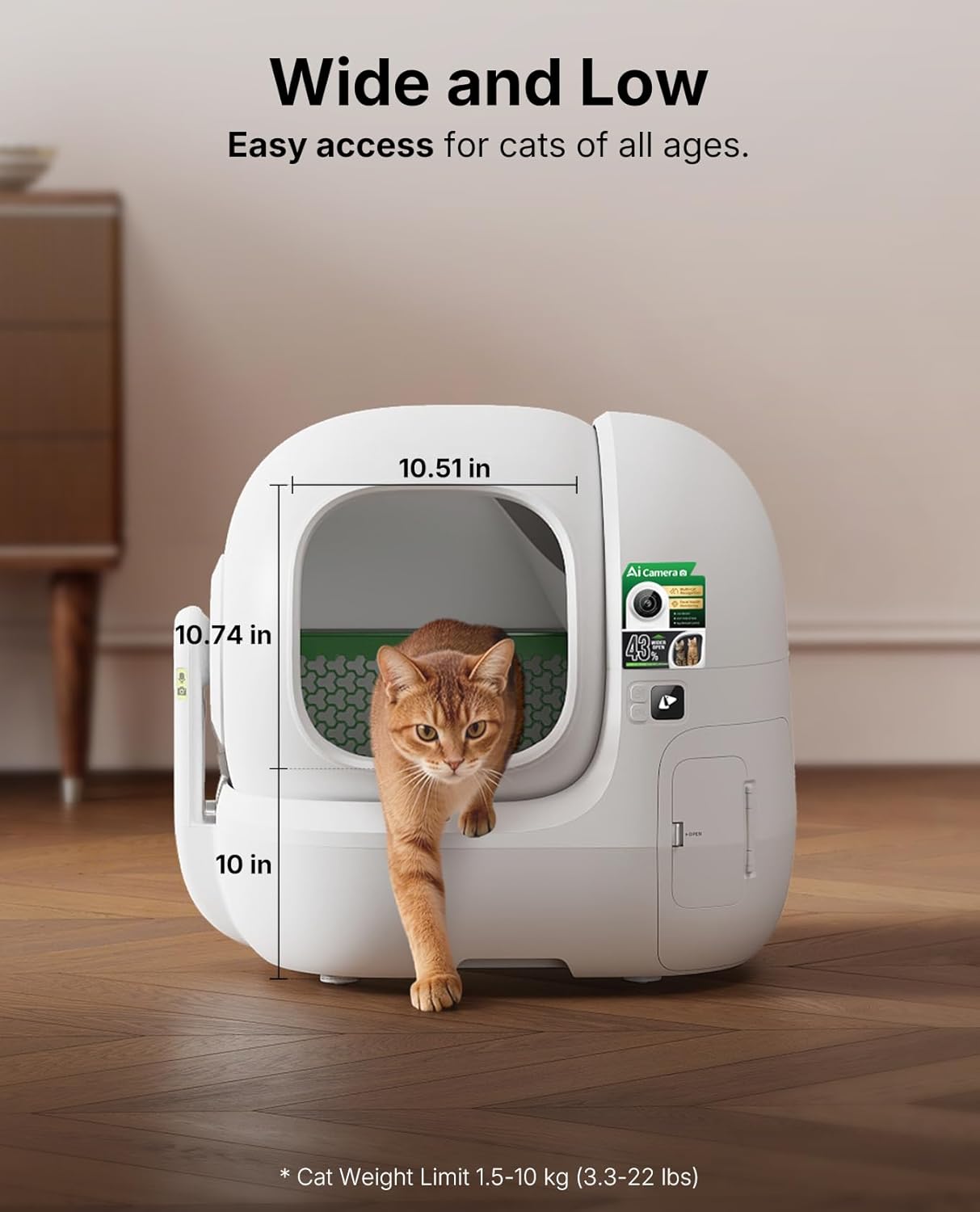
Imagine a litter box that texts you when your cat spends too long inside, logs every visit, photographs the waste, and flags when something looks off — before your cat starts hiding under the bed or refusing food. That’s the pitch behind a new wave of AI camera litter boxes hitting the market in 2025 and 2026. “AI camera” here means the unit has a built-in lens plus software that analyzes what it sees: waste shape, color, and volume, combined with weight sensor data, to build a per-cat health profile over time. For a multi-cat household where one shy tabby could be quietly developing kidney trouble while everyone else acts normal, the idea is genuinely compelling. This article breaks down whether the technology actually delivers on that promise, which units are doing it best right now, and — critically — when you’re better off skipping the camera premium entirely.
What “AI Health Monitoring” Actually Means in a Litter Box
Let’s be precise about the term, because manufacturers use it loosely. Almost every self-cleaning litter box sold above $150 today includes a weight sensor — a scale built into the base that logs how heavy a cat is when it steps in. That’s useful baseline data, but it’s not AI. True AI camera monitoring adds a second layer: a lens (usually mounted inside the globe or hood) that captures an image or short video of each waste deposit, then runs it through an on-device or cloud model to assess consistency, color, quantity, and unusual characteristics.
The distinction matters for your buying decision because the camera models cost more, introduce new failure points (lens fog, poor lighting, image misclassification), and generate far more data — not all of which is actionable. Understanding what each tier actually tracks is the first step to deciding whether the upgrade is worth it.
The two tiers at a glance:
| Capability | Weight-only units | AI camera units |
|---|---|---|
| Per-visit weight log | ✓ | ✓ |
| Usage frequency tracking | ✓ | ✓ |
| Waste photo/video capture | ✗ | ✓ |
| Stool consistency analysis | ✗ | ✓ (model-dependent) |
| Multi-cat facial ID | ✗ | ✓ (model-dependent) |
| Vet-shareable health report | Partial | More complete |
The Units Worth Knowing Right Now
PETKIT Purobot Max Pro 2
This is currently the most-discussed camera-equipped unit in enthusiast communities. Owners reviewing it consistently praise the waste photo capture as genuinely useful — not a gimmick — and note that the images are clear enough to actually flag changes in stool consistency over time. One frequently cited data point from multi-cat households: all four cats in a home adopted it with minimal friction, which is notable given how finicky cats can be about enclosed spaces with new smells and moving parts.
The caveat that surfaces repeatedly is the slow cycling speed. PETKIT intentionally slows the globe rotation between uses as a safety measure to reduce the risk of entrapment, but in a busy multi-cat home this creates a queuing problem — cats arriving for back-to-back visits may find the unit still mid-cycle. This isn’t a defect; it’s a deliberate design tradeoff. But if you have four cats and one is diabetic with high visit frequency, it’s something you need to plan around.
PETLIBRO Luma
PETLIBRO’s camera model draws strong owner praise for its 15-minute deep-clean cycle and the AI camera feature set. The picture that emerges from aggregated reviews is a well-executed mid-tier option that takes the category seriously. One important caveat for researchers: at least one published review of the Luma is clearly misdirected — the reviewer describes what sounds like a feeding mat — suggesting product-listing confusion on certain retail aggregators. Filter your review sourcing carefully; a misdirected review can skew star ratings in either direction.
PETKIT PuraMax 2 (no camera)
Here’s a useful comparison anchor. The PuraMax 2 doesn’t include a camera, but owners consistently single out its weight tracking as a standout feature. One reviewer noted it “registers my cat’s weight and shows I can track their weight” in a way that felt meaningfully different from competitors — presumably because the readout and trend visualization in the PETKIT app are well-implemented. If you’re evaluating whether to pay the camera premium, the PuraMax 2 is the honest baseline: it demonstrates that weight-only monitoring, done well, is genuinely useful.
CATLINK Open-X
The CATLINK story is instructive for anyone evaluating a brand’s long-term reliability. Owners report that the weight sensing on a first unit failed — a legitimate hardware defect — but customer service resolved it by sending a replacement. The reviewer ended up with two units running simultaneously on one app, which is either a frustrating outcome or a lucky bonus depending on your perspective. The key takeaway: CATLINK’s app handles multi-unit households gracefully, and the company appears to honor replacements. But weight-sensor failure on initial units is a pattern worth monitoring if you’re considering this brand at scale.
UPFAS
At the budget end, UPFAS owners report that the weight and usage monitoring app works reliably for the price point. This matters because it establishes a floor: even at a budget price, basic monitoring can function correctly. UPFAS isn’t competing with the Purobot Max Pro 2 on camera features, but for a single-cat household tracking whether an older cat’s visit frequency is declining, the monitoring works.
Petcove
One Petcove owner provided one of the more clinically meaningful data points in recent owner reviews: the weight monitoring helped them catch changes in a diabetic cat’s urination pattern. This is exactly the use case the category is built around. Diabetic cats urinate more frequently and in larger volumes when blood sugar is poorly controlled; a litter box that logs visit frequency and duration creates a paper trail a vet can actually use. The Petcove review is anecdotal, but it’s the kind of anecdote that validates the premise.
When the Camera Premium Is Worth It (and When It Isn’t)
Here’s the decision framework, stated plainly.
Pay for the camera if:
- You have a cat with a diagnosed condition (diabetes, CKD, FLUTD) where stool and urine changes are direct clinical signals. Per PetMD’s overview of feline lower urinary tract disease, changes in urine color, frequency, and volume are among the earliest detectable indicators of a flare — and a camera gives you visual documentation.
- You have three or more cats and you genuinely cannot observe each individual’s litter habits. Multi-cat households are exactly where facial recognition and per-cat logging justify the cost premium.
- Your vet has indicated they’d find longitudinal trend data useful. VetStreet’s overview of kidney disease in cats notes that early-stage CKD often presents as subtle behavioral shifts — increased water intake, slightly more frequent urination — that owners notice intuitively but can rarely document with timestamps.
Skip the camera if:
- You have one or two cats you observe daily. You will notice changes before an app does, and The Spruce Pets’ guide to monitoring litter box habits reinforces that attentive daily observation remains the most reliable detection method.
- Your primary concern is odor, waste management, or convenience — not health monitoring. The camera adds complexity and a failure point without meaningfully improving those outcomes.
- You’re in the sub-$200 tier and evaluating first-time purchase. A reliable weight-tracking unit like the PuraMax 2 gives you most of the health-relevant data at lower risk of a camera-related malfunction.
The Multi-Cat Problem: Does Facial Recognition Actually Work?
This is the hardest technical challenge in the category, and the honest answer as of mid-2026 is: sometimes, with meaningful caveats.
Facial recognition in litter boxes uses a camera image captured as the cat enters to match against a stored profile. In ideal conditions — good lighting, cats with visually distinct markings, and a camera positioned at the entrance — it works reasonably well. The accuracy degrades with cats that look similar (littermates, same coat color), dark or long-haired cats that are harder to distinguish in low-light captures, and high-traffic periods where the camera doesn’t have a clean frame.
The iHeartCats editorial on litter box health signals notes that per-cat attribution is most critical in multi-cat homes precisely because health changes in one cat get masked by aggregate data. If your monitoring system can’t reliably separate Mochi from Miso, the trend data loses clinical value quickly. The practical workaround most multi-cat owners land on: use the camera data as a flag system rather than a precise diagnostic tool. When the app signals a significant deviation from baseline — more visits, longer duration, unusual waste appearance — that’s your cue to observe directly and schedule a vet check, not to treat the app’s per-cat attribution as authoritative.
Frequently Asked Questions
1. Can these boxes actually tell my vet anything useful about my cat’s health?
Yes, with the right framing. Weight trends, visit frequency, and duration logs exported from a well-implemented app give your vet longitudinal data they can’t get from a single exam. What they can’t do is replace bloodwork or urinalysis. Think of the litter box data as a between-visit monitoring layer — it tells your vet what’s been changing, not what’s causing it. Companion Animal Psychology’s research on cat environmental monitoring reinforces that behavioral baselines captured over weeks are more meaningful than point-in-time observations.
2. Do AI cameras work accurately when I have multiple cats using the same box?
Aggregate data (total visits, total waste volume) is accurate. Per-cat attribution depends heavily on the facial recognition quality and how visually distinct your cats are. In general, camera units perform better in multi-cat homes than weight-only units, but expect some misattribution — especially in high-traffic windows.
3. Is facial recognition reliable enough to separate per-cat data?
Reliable enough to be useful; not reliable enough to be definitive. Treat it as 70–85% accurate in typical home conditions, higher if your cats have distinctive markings and the camera has a clean sightline. Use deviations as triggers for direct observation, not as standalone diagnoses.
4. Does the weight sensor work correctly from day one or does it need calibration?
Most units require a brief calibration period — typically 3–7 days of baseline readings — before trend data becomes meaningful. CATLINK’s weight-sensor failure on an initial unit is a reminder that this component can fail; verify within the return window. UPFAS and PETKIT units generally calibrate reliably within the first week based on owner reports.
5. How do AI camera litter boxes compare to color-change litters like PrettyLitter for health monitoring?
They’re measuring different things. PrettyLitter changes color in response to pH and blood markers in urine — it’s a passive chemistry test that runs every time the cat eliminates. An AI camera litter box logs behavioral patterns (frequency, duration, volume) and visual waste characteristics. Ideally, you’d use both in a high-risk cat, but if forced to choose: for a cat with urinary health concerns, color-change litter gives you faster chemical signal. For a cat with metabolic or weight-related concerns, the litter box’s longitudinal data is more valuable.
6. Is the camera upgrade worth the extra cost over a standard weight-tracking unit?
For a single healthy cat: probably not. The weight-tracking data from a unit like the PuraMax 2 covers most health-monitoring use cases at lower cost and complexity. For a multi-cat home, a senior cat, or a cat with a diagnosed condition — yes, the camera upgrade earns its premium. The Purobot Max Pro 2 represents the current high-water mark for camera execution; the PETLIBRO Luma is a credible alternative. If your use case is primarily convenience with monitoring as a secondary benefit, start with weight-only and upgrade if you need more granularity.
The bottom line: AI camera litter boxes are real technology solving a real problem — they’re just not magic. The clearest ROI is in multi-cat homes and households managing a cat with a known health condition. For everyone else, a well-implemented weight tracker is an honest, lower-risk starting point.