August 5, 2026 • Margot Vellacourt • 11 min reading time • Prices verified June 4, 2026
The Best Litter for Automatic Boxes: Clay, Tofu, Walnut, and Pellet Systems Tested by Real Owners
If you’ve ever dropped $500 on a self-cleaning litter box — the kind that spins, rakes, or rotates on a timer so you’re not scooping manually — and then poured in the wrong litter, you already know what happens. Clumps stick to the walls. The rake jams. The sensor fires at the wrong moment. The whole system stops working the way it’s supposed to. That’s what this guide is about: matching the right litter type to the right machine, so your investment actually delivers. We’re covering four major litter categories — clumping clay, tofu (made from soybean fiber), walnut shell, and pellet systems — and grounding every recommendation in what real owners have reported across long-run use. If you’re new to automatic boxes entirely, the short version is this: these machines have mechanical parts, sensors, and sometimes app-connected health monitors, and the litter you choose affects all three. Get it wrong and you’re not just dealing with mess — you’re shortening the life of hardware you paid serious money for.
Why Litter Compatibility Is the Variable Most Reviews Ignore
Here’s the thing most hardware reviews skip entirely: the litter is a consumable that interacts with your machine’s mechanics every single day. A rake-style box (think linear track, a tined bar that pushes waste to one end) behaves very differently from a globe-style rotating drum like the Litter-Robot 4. A spray-nozzle self-cleaning system like the PETKIT PURA series has different drainage tolerances than either. The litter you buy isn’t just about odor — it’s about clump hardness, granule size, dust output, and how cleanly the waste separates from the usable litter when the machine cycles.
The Spruce Pets’ 2025 automatic litter box roundup notes that manufacturers almost universally recommend “clumping clay” as the safe default — but that recommendation papers over real-world variation within clay itself, and it ignores the growing body of owner experience with alternative materials that, in some machines, genuinely outperform clay.
The decision frame, before we go deeper:
- Globe/drum-style (Litter-Robot 3, 4, 5): prioritize non-stick clump behavior and low dust
- Rake-style (PetSafe ScoopFree): often locked to crystal pellets by design
- Spray/self-wash (PETKIT PURA X, MAX, Popur X5): need fast-dissolving clumps, tight pellet tolerance
Clumping Clay: The Default With a Catch
Clay is where most owners start, and it’s a reasonable default — but not all clay is the same, and that difference matters inside a machine.
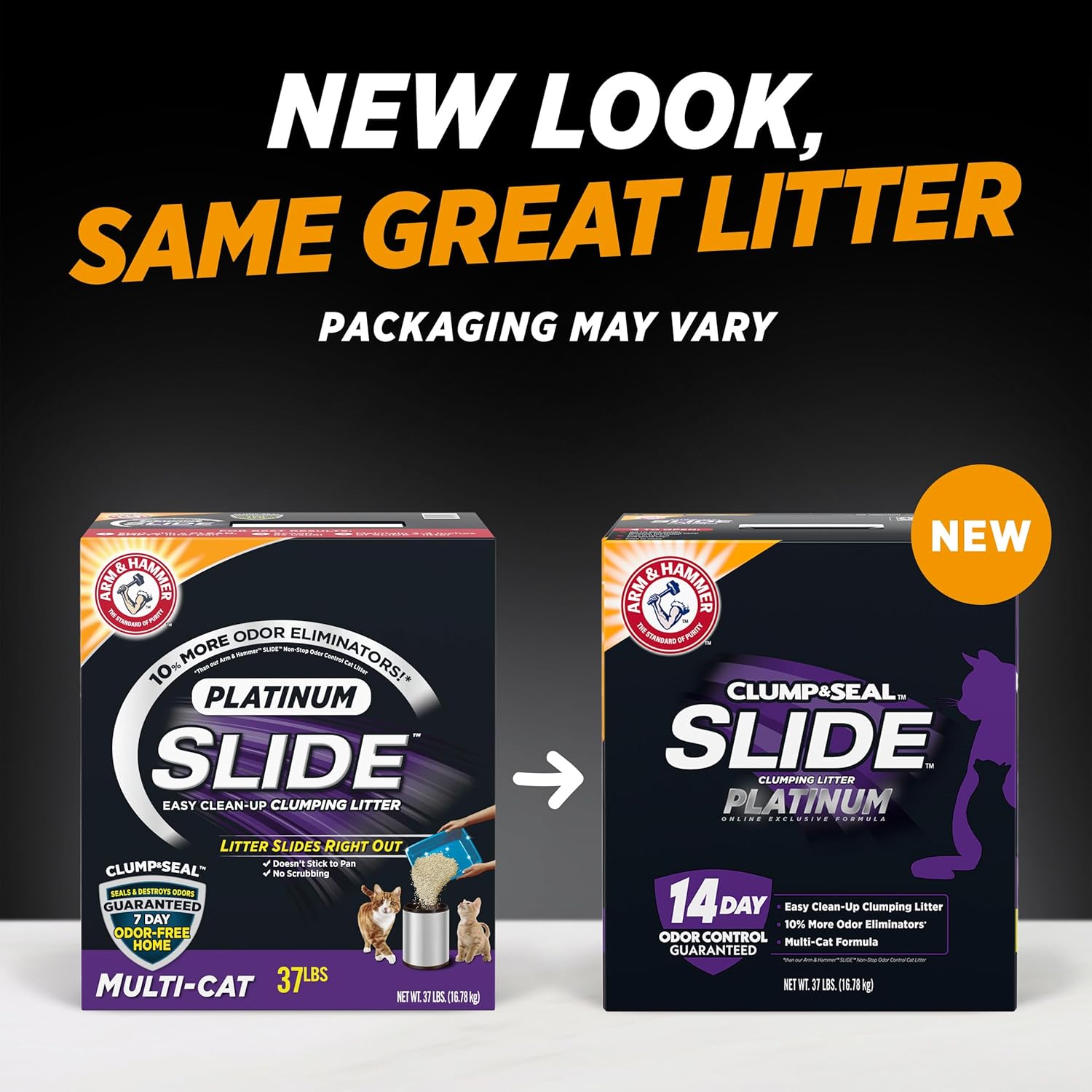
The most specific long-run data point in owner communities involves ARM & HAMMER Clump & Seal SLIDE Platinum. One Litter-Robot 4 owner who spent a full year cycling through alternatives named it the clear winner, specifically citing the non-stick “Slide” technology in the formula. The claim: clumps release cleanly from the interior globe surface instead of adhering and building up a calcified layer that eventually requires manual scrubbing. If you’ve ever had to chip dried clumps off the inside of a rotating drum, you understand why this matters. The Slide formula isn’t just a marketing badge — owners report measurably less cleanup and more consistent cycling behavior over months of use.
The tradeoff with clay generally — and this is flagged repeatedly by owners of Dr. Elsey’s Ultra, one of the category’s perennial top-sellers — is granule breakdown over time. Dr. Elsey’s Ultra owners consistently praise its odor control, and PetMD’s editorial overview of litter types confirms that sodium bentonite clay (the active clumping agent in most premium clays) offers strong odor containment. But owners specifically flag that as granules fracture with repeated use, the fine dust they generate increases — and that dust accumulates on optical sensors and weight plates inside machines like the Litter-Robot 4 and PETKIT PURA MAX. In a machine that uses sensor data to track your cat’s weight and visit frequency as a health signal, sensor contamination isn’t just an annoyance. It degrades the data quality the whole app-monitoring system depends on.
By the numbers:
| Litter type | Avg. monthly cost (2-cat household) | Sensor-safe rating (owner-reported) | Clump stick risk (globe units) |
|---|---|---|---|
| Clay (ARM & HAMMER SLIDE Platinum) | ~$18–22 | Moderate (low-dust formula helps) | Low (Slide formula) |
| Clay (Dr. Elsey’s Ultra) | ~$16–20 | Lower over time (dust increases) | Medium |
| Tofu (PETKIT Clump+) | ~$22–28 | High | Very low |
| Walnut shell (Naturally Fresh) | ~$20–25 | High | Low |
| Zeolite pellets (Honey Care) | ~$10–14 | High | N/A (pellet system) |
Tofu Litter: The Alternative That’s Earning Real Converts
Tofu litter is made from compressed soybean fiber — it clumps on contact with moisture, dissolves partially in water (making it technically flushable in small quantities, though local plumbing rules vary), and produces almost no airborne dust. iHeartCats’ overview of tofu cat litter notes that the format has improved substantially in clump hardness over the past two years, addressing the main early complaint that tofu clumps crumbled during mechanical cycling.
The most relevant recent data point: PETKIT Clump+ Tofu’s updated formula. Owners using it in both the Litter-Robot 5 and the Popur X5 specifically report that the revised formula “finally works better than clay” for automated cycling — clumps hold together through rotation without sticking to surfaces, and one Popur X5 owner explicitly confirms zero tracking with that combination. Tracking (litter granules carried out on paws and scattered on floors) is one of the friction points that erodes owner satisfaction over time, and the larger pellet size in quality tofu litters mechanically reduces it.
The nuance worth naming: tofu doesn’t work uniformly across all machines. Very fine tofu granules can interfere with some sensors, and in machines with narrow drainage channels (certain PETKIT spray-wash cycles), undissolved pellet fragments can cause partial blockages. The PETKIT Clump+ formula appears specifically engineered to avoid this in PETKIT hardware — but owners running it in globe-style units report equally positive results, so it’s not exclusively proprietary.
On the pH detection feature: PETKIT also sells a tofu litter with pH-reactive color change — the litter shifts color to indicate acidic urine, which can be an early signal of urinary tract issues. The enthusiasm for this feature in owner communities is genuine. The caveat is also genuine: owners report that PETKIT’s own machine occasionally over-reacts to pH readings, triggering alerts for normal urine variation. The feature doesn’t require a PETKIT box — the color change is visual, readable by any owner — but the automated alert integration only functions within the PETKIT app ecosystem. As a standalone health-monitoring tool, it provides a useful visual flag. As a data stream into a broader health dashboard, it’s currently PETKIT-only.
Walnut Shell and Pellet Systems: The Overlooked Options
Walnut shell litter (Naturally Fresh is the category name most owners encounter) is a clumping litter made from ground walnut shells. It’s darker than clay, which surprises some owners, but the clumping performance is solid and the dust profile is low. One owner explicitly confirms automatic box compatibility with Naturally Fresh, reporting positive results in a rake-style unit. The dark color does make it harder to visually scan for waste when spot-checking — a minor UX friction point. It’s not widely tested across globe-style units in owner reports, so if you’re running a Litter-Robot 4, the clay-vs-tofu decision is better-validated.
Pellet systems are a different category entirely. The PetSafe Breeze system — one of the few automatic rake units specifically designed around a pellet-and-pad format — uses large plastic-mesh pellets that allow liquid waste to drain through to an absorbent pad below, while solid waste sits on top for rake removal. The system works, but the Breeze-branded pellets carry a significant ongoing cost. The relevant data point for cost-conscious owners: Honey Care zeolite pellets are validated by multiple Breeze system owners as a direct, cost-effective substitute. Zeolite is a naturally porous mineral that absorbs ammonia passively — similar odor control mechanism to the Breeze pellets, at meaningfully lower cost.
The annual math on Breeze vs. Honey Care zeolite (one-cat household):
- PetSafe Breeze pellets: ~$120–140/year (pellets + pads)
- Honey Care zeolite pellets + generic absorbent pads: ~$55–70/year
- Estimated annual savings switching to Honey Care: $50–80
Over five years, that’s $250–400 in consumable savings on a unit that costs $130 to buy. The consumable math routinely exceeds the hardware cost — which is why this site treats it as the more important number.
Dust and Respiratory Sensitivity: The Underweighted Variable
Modern Cat’s editorial coverage of litter dust and cat respiratory health makes the underlying point plainly: fine airborne silica particles from low-quality clumping clay are a documented irritant for cats with asthma and for human owners with dust sensitivity. The practical takeaway for automatic box owners is that the machine’s cycling mechanism — rotating, raking, or agitating — creates more airborne disturbance than manual scooping, so a borderline-dusty litter becomes a worse-than-borderline litter in an automated context.
Owner-reported low-dust rankings, across aggregated long-run reviews:
- Tofu litters (PETKIT Clump+, other soybean formats) — consistently lowest dust
- Walnut shell (Naturally Fresh) — low dust, slight tracking from lighter weight
- Clay with low-dust engineering (ARM & HAMMER SLIDE Platinum, Dr. Elsey’s Ultra initially) — moderate
- Standard clay (store-brand, unspecified economy clays) — highest dust, worst for sensors and respiratory health
If anyone in your household has asthma, or if one of your cats has a history of respiratory sensitivity, the tofu category should be your first stop, not your experiment.
Frequently Asked Questions
Will tofu litter clog or damage a Litter-Robot 4’s mechanics? Based on owner reports, quality tofu litters with larger pellet sizes — including PETKIT Clump+ — do not clog the Litter-Robot 4’s globe or waste port. The key variable is pellet size: ultra-fine tofu powder can accumulate in sensors, but formed pellets behave well. Owners recommend avoiding bargain tofu brands with inconsistent pellet compression.
Does the ARM & HAMMER SLIDE formula actually prevent clumps from sticking inside a globe-style box? Owner reports specifically confirm this. The non-stick chemistry in the SLIDE Platinum formulation produces clumps that release from the globe’s interior surface more cleanly than standard clay. One year of documented use in a Litter-Robot 4 supports the claim.
Can I use walnut shell litter in a standard rake-style automatic box? Yes, with one caveat. Owner experience with Naturally Fresh confirms compatibility in rake-style units. The darker color makes visual inspection harder, and it hasn’t been as widely documented in globe-style units — but there’s no mechanical reason it wouldn’t work in either.
What is the real cost difference between Breeze pellets and Honey Care zeolite pellets per year? Multiple Breeze system owners validate Honey Care zeolite as a functional substitute. The annual savings for a one-cat household run approximately $50–80, or $250–400 over five years. For a multi-cat household, the gap widens.
Does the PETKIT tofu litter’s pH detection feature work reliably, and does it require a PETKIT box? The color-change feature is visual and works independent of any machine — any owner can observe the shift. The automated app alert integration requires a PETKIT unit. Reliability: owners report occasional false positives, where normal urine variation triggers an alert. As a directional early-warning tool it’s useful; as a clinical diagnostic tool it isn’t, and your vet will confirm that an alert warrants a urinalysis, not a diagnosis on its own.
Which litters create the least dust for cats and owners with respiratory sensitivities? Tofu-based litters, particularly soybean-fiber formats, consistently rank lowest in owner-reported dust across aggregated reviews. Walnut shell is second. Premium low-dust clay formulations are third. Standard economy clay is the worst-performing category in both sensor contamination and respiratory impact — avoid it in any automatic unit.
The Decision Rule
If you’re running a globe-style unit (Litter-Robot series): start with ARM & HAMMER SLIDE Platinum if you want to stay in clay, or move to PETKIT Clump+ Tofu if dust or tracking is your friction point. Both have documented compatibility and owner-validated long-run performance.
If you’re running a PETKIT PURA or Popur X5: the PETKIT Clump+ Tofu is the highest-confidence choice — owner reports confirm zero tracking specifically in the Popur X5, and the formula is engineered for these machines’ cycling mechanics.
If you’re running a Breeze or similar pellet system: Honey Care zeolite is the cost-rational substitute. Validate the pellet size matches your unit’s mesh tray before committing to a bulk purchase.
If anyone in your household has respiratory sensitivity: skip the clay comparison entirely and go straight to tofu. The dust reduction is material, not marginal, and in an automated box that cycles multiple times daily, it compounds.
The litter decision is a five-year decision, not a bag decision. The machine is the hardware. The litter is the operating cost — and in most setups, it will cost you more than the machine before year three.