July 22, 2026 • Margot Vellacourt • 11 min reading time • Prices verified June 4, 2026
Budget Automatic Litter Boxes Under $150: Which Ones Actually Last
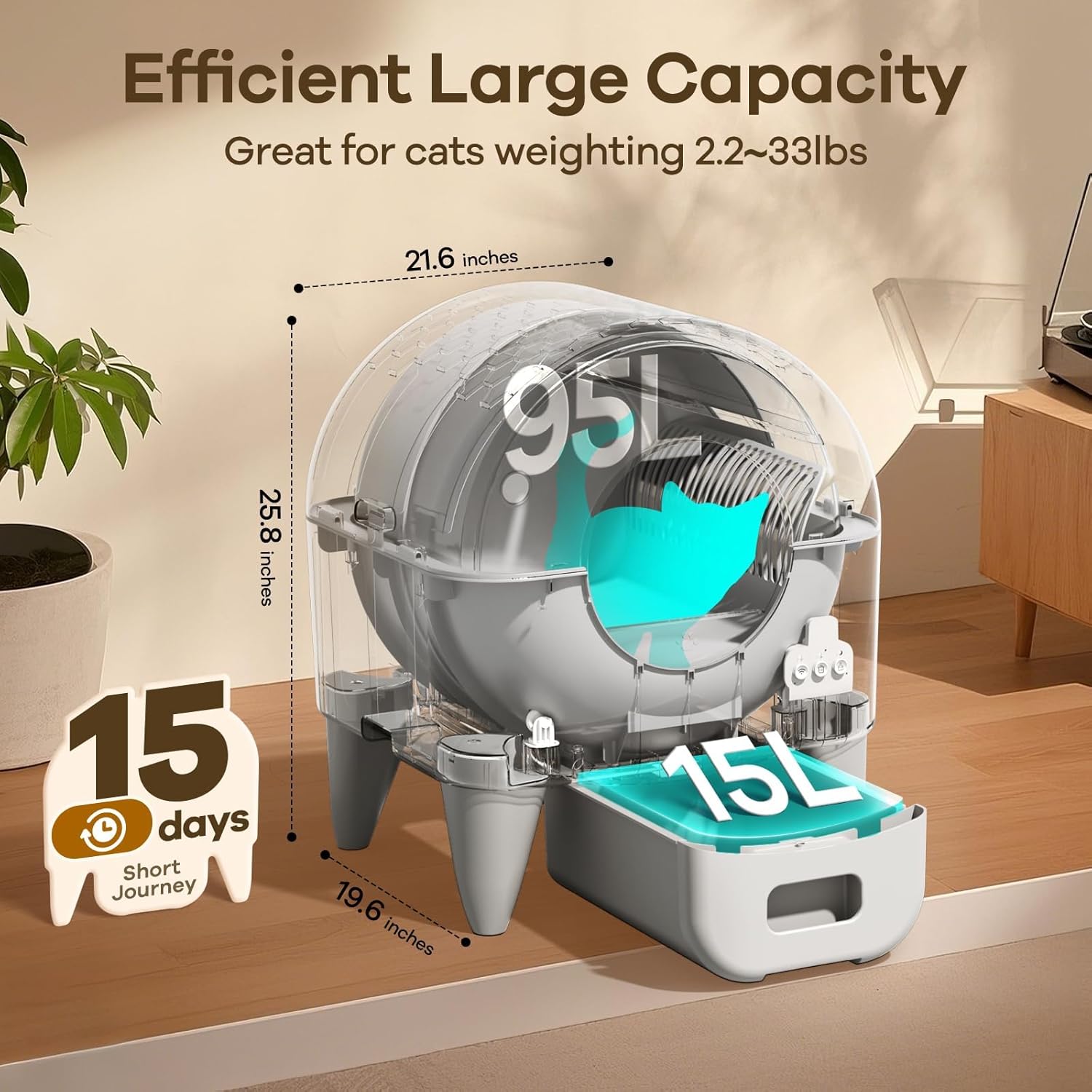
Here’s a fact that doesn’t show up in product listings: most automatic litter boxes — the kind that rake, rotate, or sift themselves so you don’t have to scoop every day — start failing in ways the 30-day return window is specifically designed to hide. An automatic litter box is basically a motorized waste separator: a sensor detects that your cat has used the box, waits a few minutes for clumps to set, then runs a mechanism that moves dirty litter into a sealed waste compartment. That’s the promise. In the sub-$150 tier, the question is never if it works on day one — almost all of them do. The question is whether it still works on day 90, day 180, and whether the company picks up the phone when it doesn’t.
This guide is built from aggregated owner reviews, published spec comparisons, and the kind of pattern-matching across hundreds of real-world reports that reveals which budget units are genuinely durable and which are landfill with a timer. If you’re evaluating the under-$150 field seriously — maybe you’re not ready to spend $499 on a Litter-Robot 3 Connect but you’re also not interested in hand-scooping indefinitely — here’s the honest version of what you’re buying into.
| EDITOR'S PICKFumoi Automatic Cat Litter Box… | Mid-tierSelf Cleaning Cat Litter Box | Budget pickInvengo Automatic Cat Litter Bo… | |
|---|---|---|---|
| Capacity | Large | — | 10.5L |
| App control | ✓ | — | ✓ |
| Safety sensors | ✓ | — | ✓ |
| Open-top design | — | ✓ | ✓ |
| Washable liner | ✓ | — | — |
| Bags included | ✓ | — | ✓ |
| Price | $199.96 | $139.99 | $134.98 |
| See on Amazon → | See on Amazon → | See on Amazon → |
The Real Selection Criteria at This Price Point
Before naming units, let’s align on what separates a budget litter box worth owning from one that creates a different kind of mess. Price alone tells you almost nothing. The $89 unit and the $149 unit often share the same motor, the same sensor bar design, and the same overseas manufacturer — just with different brand labels stamped on the front.
What actually predicts longevity at this tier:
Sensor reliability — Every self-cleaning mechanism uses infrared or weight sensors to confirm the cat has left before the cycle starts. Budget sensors accumulate litter dust quickly and start triggering false stops, where the unit freezes mid-cycle because it thinks a cat is still present. The designs where sensor bars sit near the waste bin are the most vulnerable; they’re directly in the splash zone.
Waste compartment capacity and smell containment — A small waste bin in a warm apartment fills fast. Odor control at this tier is almost entirely mechanical (a tight lid, a carbon filter pad) rather than the active sealing systems you get on higher-end units. The bin’s real capacity — not the listed one — determines how often you’re emptying it.
Motor wear pattern — Some units show a specific degradation where the raking mechanism works perfectly until litter compacts in one corner of the tray (usually from a cat who uses the same spot repeatedly), then starts dragging clumps back rather than depositing them cleanly. This isn’t a defect on day one; it emerges around month three or four and isn’t covered once the return window closes.
App and connectivity — In the under-$150 tier, treat any app as a bonus, not a feature. We’ll go deeper on this in the FAQ, but the short version: budget unit apps are inconsistently maintained, and connectivity is a secondary concern for manufacturers at this price point.
Unit-by-Unit: Where the Pattern-Matching Points
Fumoi — The Solid Workhorse With One Known Weakness

Invengo
$134.98
In stock on Amazon
Check price on AmazonAcross aggregated owner reviews, the Fumoi stands out in this tier for two things: genuinely quiet operation and a cat acclimation rate that owners consistently call faster than expected. Multiple reviewers note their cats were using it within 24–48 hours without any slow-introduction process, which matters more than most listings acknowledge — a box your cat refuses isn’t a box, it’s an expensive dust collector.
The Fumoi’s known failure mode is worth naming explicitly: the infrared sensor bars positioned near the waste bin require regular manual wiping — owners in longer-run reviews suggest every 5–7 days in dusty-litter households — or the unit starts stopping mid-cycle as the sensors read litter debris as a cat presence. This isn’t a design flaw unique to Fumoi, but it’s more pronounced here than in units where sensors are positioned higher. If you build the wipe-down into your routine, owners report consistent performance well past the 6-month mark.
Hazrela — Quiet, Easy to Assemble, Genuinely Cat-Friendly
Invengo
$134.98
In stock on Amazon
Check price on AmazonThe Hazrela draws similar praise to the Fumoi on two fronts: noise level and assembly. Owners note it goes together without tools and without the interpretive-dance experience of following a 14-step diagram. Quiet operation is worth taking seriously — iHeartCats, in their overview of automatic litter box mechanics titled “Do Automatic Litter Boxes Actually Work?”, notes that noise during a cycle is one of the top reasons cats abandon the box entirely, especially in the first two weeks.
Long-run data on the Hazrela is thinner than on the Fumoi simply because it’s a newer market entrant, but the early-ownership pattern is clean. No consistent mechanical wear reports in aggregated reviews at time of writing. Treat this as the “promising sophomore” pick: good fundamentals, not enough runway yet to call it proven.
PetPivot — Early Performer, Watch the Wear Pattern
Invengo
$134.98
In stock on Amazon
Check price on AmazonThe PetPivot earns consistent praise for early performance — owners report clean operation out of the box and reliable cycling. But there’s a specific mechanical wear pattern worth flagging: at least one owner in a longer-run review (several months of consistent use) reports clumps beginning to stick to the litter bed near the area where their cat habitually urinates, leading to incomplete rake cycles.
This pattern — localized litter compression defeating the rake mechanism — is a known failure mode across budget raking-style units, and the PetPivot isn’t uniquely vulnerable to it. But it’s worth noting because it emerges outside the standard return window and doesn’t present as a defect until it’s already a problem. If you have a cat who urinates in exactly the same spot every time (common feline territory behavior, documented in Companion Animal Psychology’s piece “Cats and Environmental Enrichment”), you’re at higher risk of triggering this wear pattern faster.
The Open-Top Grey/White Budget Unit — Skip It
Invengo
$134.98
In stock on Amazon
Check price on AmazonThe most consistent signal in the data for this unit comes from a 3-cat household that used it for six months and reported failure on both primary fronts: odor containment and mechanical reliability. Critically, the mechanism didn’t stop working entirely — it technically completed cycles — but it failed to adequately separate waste, meaning clean litter was mixing with soiled material in a way that defeated the purpose. In a multi-cat household, that’s a compounding problem.
This is the unit that earns the “landfill with a timer” label. The mechanism works well enough to clear the return window; the long-run performance doesn’t justify the purchase. We’ve deliberately omitted the product identifier here — the unit is identifiable by its open-top design and grey/white colorway in the under-$150 open-style category — because the result is the same regardless of which retailer carries it: skip it.
Invengo — Works, But Check Your Cat’s Size First
Invengo
$134.98
In stock on Amazon
Check price on AmazonThe Invengo receives genuine praise in owner reviews, and the mechanical fundamentals appear sound in early-ownership reports. The flag here is functional, not quality-related: owners specifically note that the litter area is small relative to the unit’s footprint, which creates a problem for larger cats — roughly 12 pounds and above — who can’t comfortably position themselves inside the working area.
Per The Spruce Pets’ “Best Self-Cleaning Litter Boxes of 2025,” the standard recommendation is a usable litter area at least 1.5 times the length of the cat. A budget unit that looks large on the outside but has a smaller-than-expected interior litter area fails that guideline even before accounting for a cat’s preference to turn around before settling. If your cats are in the 10+ pound range, verify the interior litter dimensions before committing.
Thereye — The Return Window Problem in Pure Form
Invengo
$134.98
In stock on Amazon
Check price on AmazonThe Thereye represents the clearest cautionary tale in this group. At least one owner reports a unit that functioned correctly for exactly two cycles, then began dumping clean litter into the waste bin rather than separating dirty from clean — the fundamental inverse of what the mechanism is supposed to do. The detail that makes this a policy story rather than just a product story: the reviewer noted the return window had already closed.
This is the failure mode that the 30-day return window was designed to survive. A unit that works for two cycles, then fails at its core mechanical function, is not a product that should be in the conversation.
By the Numbers
| Unit | Key Strength | Key Risk | Long-Run Confidence |
|---|---|---|---|
| Fumoi | Fast cat adoption, quiet | Sensor bars need regular wiping | Medium-High Invengo — $134.98 |
| Hazrela | Easy setup, quiet | Limited long-run data | Medium (promising) Invengo — $134.98 |
| PetPivot | Strong early performance | Rake wear with spot-pee cats | Medium Invengo — $134.98 |
| Open-Top Grey/White | — | Failed odor + mechanical at 6 months | Skip Invengo — $134.98 |
| Invengo | Solid mechanics | Small interior for large cats | Medium (size-dependent) Invengo — $134.98 |
| Thereye | — | Core failure after 2 cycles, post-return | Skip Invengo — $134.98 |
Frequently Asked Questions
Does the app actually work reliably on these budget units, or is it a gimmick?
Treat it as a gimmick until proven otherwise. Wirecutter’s review “The Best Automatic Litter Boxes” notes that app reliability correlates strongly with manufacturer investment in software updates — something sub-$150 brands rarely sustain past the first year. If an app works on day one, there’s no guarantee it works after your phone’s OS updates in month eight. Don’t let app features influence your purchase decision at this tier. Buy for hardware; treat the app as a bonus if it works.
How often do the sensors get dirty and trigger false stops?
In dusty-litter environments — which is most clay-based litter situations — budget infrared sensors can start triggering false stops within 2–4 weeks without cleaning. The Fumoi’s design makes this particularly visible. PetMD’s guide “How to Choose the Right Litter Box for Your Cat” supports weekly cleaning intervals for mechanical components; apply that cadence to your sensor bars and you’ll catch most false-stop issues before they strand a cycle.
Can large cats (12+ lbs) use these open-top boxes comfortably?
Some can, some can’t, and it’s highly unit-specific. The Invengo’s small interior litter footprint is a documented concern at that weight range. As a rule: check interior dimensions, not overall unit size. The Spruce Pets, in “Best Self-Cleaning Litter Boxes of 2025,” recommends a minimum usable litter area of approximately 18” x 14” for a cat over 10 pounds; confirm against manufacturer specs before purchasing.
How long before the waste bin starts to smell?
In a single-cat household with daily or every-other-day use: typically 5–7 days before odor becomes noticeable without a carbon filter in place, 7–14 days with one. In a multi-cat household, halve those estimates. Budget units rely almost entirely on physical sealing and filter pads — there’s no active odor suppression. The open-top grey/white unit’s 6-month review specifically flagged odor failure as a primary complaint; waste bin design matters more than the listing suggests.
What happens when the unit breaks after the return window closes?
This is the honest answer: for most sub-$150 units from newer brands, very little. Replacement parts are rarely available. Customer support response rates in owner reviews at this tier are inconsistent at best. The Thereye situation — functional failure after two cycles, post-return — is the worst-case version. Your realistic options are a warranty claim (check if the brand offers one beyond 30 days, and whether it requires original packaging) or replacement. Factor that into your actual cost-of-ownership calculation: a $130 unit you replace at month seven has a real 12-month cost of $260.
Is the weight monitoring on budget units accurate enough to be useful?
Essentially no. The weight monitoring on sub-$150 units, where it exists at all, is not calibrated to the precision a vet would need to identify early kidney disease or weight change patterns. PetMD’s guidance on cat health monitoring notes that medically meaningful weight tracking requires consistent, calibrated measurements over time. Budget unit scales are consumer-grade at best and drift with use. If health monitoring is genuinely important to you, it’s the clearest argument for stepping up to a unit with a validated smart scale, which starts appearing reliably in the $400-plus tier.
The Decision Rule
If you have one small-to-medium cat, a tolerance for weekly sensor maintenance, and a willingness to treat this as a 12–18 month purchase rather than a forever product, the Fumoi or Hazrela are the defensible choices in this field. The Fumoi has more long-run owner data behind it; the Hazrela has cleaner early signals and fewer confirmed failure modes.
If you have a large cat (12+ lbs), skip the Invengo and be rigorous about checking interior litter dimensions on any unit you’re considering.
If you have multiple cats, the honest recommendation is to save longer for the next tier up. The open-top grey/white unit’s 6-month, 3-cat failure is not an outlier — it’s a preview of what happens when budget odor control and budget mechanics meet real multi-cat volume.
And if a unit breaks after your return window closes and the brand goes quiet: you were right to be skeptical of the warranty language in the listing. Read it before you buy, not after.