July 11, 2026 • Margot Vellacourt • 10 min reading time • Prices verified June 4, 2026
The Real Cost of Crystal Litter Systems: ScoopFree Tray Math After 12 Months
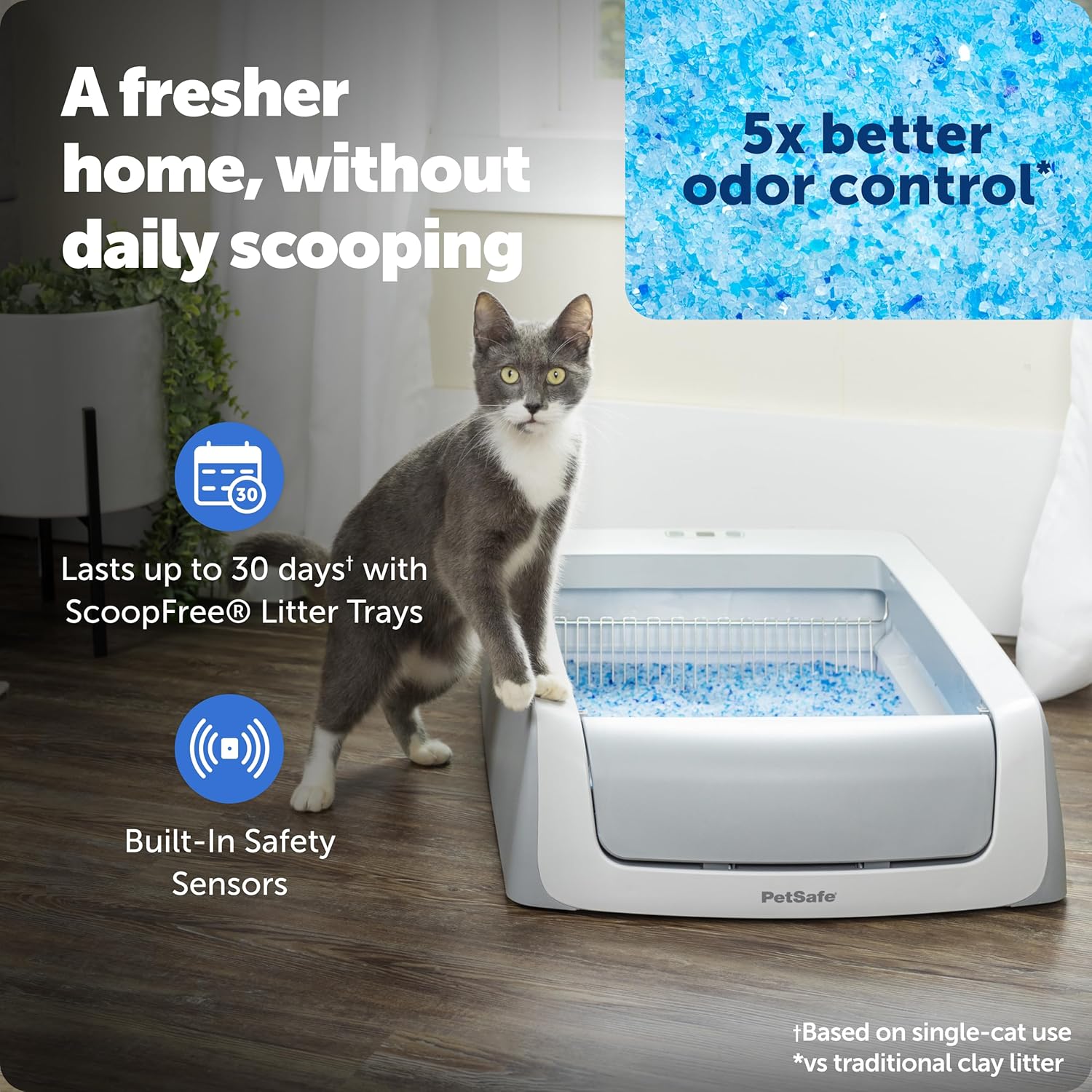
If you’ve ever seen a ScoopFree automatic litter box advertised — the kind where you supposedly swap out a disposable tray once a month and forget about scooping forever — you’ve also seen the headline claim: 30-day tray life. The “tray” here is a shallow plastic pan pre-filled with silica crystal litter, which is a type of litter made from tiny porous beads that absorb urine and dry out solid waste rather than clumping around it. The promise is simple: rake runs automatically, crystals absorb odors, tray goes in the trash at month’s end. No scooping, low maintenance, fresh-smelling apartment. That pitch is genuinely appealing, and for some households it holds up. For others — particularly those with multiple cats, a high-urination cat, or a cat managing a health condition like diabetes or kidney disease — the math falls apart fast. This article breaks down what you’ll actually spend over 12 months, which ScoopFree model you should be looking at in 2026, and when the crystal system stops making sense entirely.
| EDITOR'S PICKPetSafe ScoopFree SmartSpin Sel… | Mid-tierPetSafe ScoopFree Crystal Pro L… | Budget pickPetSafe ScoopFree Self-Cleaning… | |
|---|---|---|---|
| Odor control | ✓ | — | ✓ |
| App control | ✓ | — | — |
| Waste drawer | ✓ | — | — |
| Health counter | — | ✓ | — |
| Motion sensing | — | ✓ | — |
| Disposable tray | — | ✓ | ✓ |
| Price | $399.00 | $229.99 | $199.99 |
| See on Amazon → | See on Amazon → | See on Amazon → |
The 30-Day Tray Claim: What It Actually Means
PetSafe’s specification for the ScoopFree tray is “up to 30 days for one cat.” That caveat — one cat, up to — is doing enormous work in that sentence, and it’s where most buyer frustration originates.
Across aggregated owner reviews on major retail platforms and independent coverage from The Spruce Pets and iHeartCats, the pattern is consistent: a single, healthy, average-urination cat in a dry climate will often reach or exceed that 30-day mark. Owners in long-run reviews note getting close to 40 uses per tray under ideal conditions — which tracks with the math PetSafe is using in their marketing.
But “ideal conditions” is a narrow band.
- Two cats sharing one box: Tray life drops to roughly 10–15 days in most owner-reported scenarios. Some reviewers report as few as 8 days before odor becomes unmanageable.
- A single cat with diabetes or kidney disease: PetMD’s overview of feline diabetes notes that increased urination (polyuria) is one of the primary clinical signs — affected cats can urinate at two to four times the normal volume. Owners managing a diabetic cat report tray life collapsing to under two weeks, with some units needing replacement in 10 days or fewer.
- High-humidity environments: Crystal litter is hygroscopic, meaning it pulls moisture from the air. In humid climates or bathrooms without good ventilation, trays can saturate faster even at normal urination volumes.
One owner’s review — widely cited in community discussions and echoed in iHeartCats’ coverage — put it plainly: the system is “not for the budget minded” when your cat’s health affects urination frequency. That’s an honest framing. The 30-day number is a best-case ceiling, not a reliable planning figure.
The Annual Math: One Cat vs. Two
Here’s where this gets concrete. PetSafe’s replacement trays for the ScoopFree are sold in single units and multi-packs. As of mid-2026, single trays retail in the range of $22–$28 depending on the retailer and whether you’re buying the standard or premium (covered) version. Multi-packs of three trays offer a modest per-unit discount.
By the numbers — estimated annual tray spend:
| Scenario | Tray life | Trays/year | Approx. annual cost |
|---|---|---|---|
| 1 healthy cat, low urination | 30–40 days | 9–12 | $200–$300 |
| 1 healthy cat, average urination | 20–25 days | 15–18 | $330–$500 |
| 1 diabetic/kidney cat | 10–14 days | 26–36 | $580–$1,000+ |
| 2 healthy cats | 12–16 days | 23–30 | $500–$840 |
These figures are based on manufacturer-rated tray capacity combined with owner-reported real-world durations aggregated across review platforms and independent coverage from The Spruce Pets and Apartment Therapy. Your specific number will vary, but the ranges are honest.
The implication is significant: for a multi-cat household or a cat with elevated urination, the ScoopFree’s recurring cost can exceed the hardware cost within the first year. A unit that retails around $129 for the Crystal Classic becomes a $600–$800/year consumable commitment. That’s a different product than the sticker price implies.
Model Confusion Is a Real Problem: Classic vs. Pro Legacy vs. Smart
This is the piece of the ScoopFree puzzle that generates the most post-purchase regret, and it’s worth slowing down on.
PetSafe has sold the ScoopFree under several model names over the years, and the lineup in 2026 includes three meaningfully different products. A pattern that appears repeatedly in owner reviews — including one prominently cited by iHeartCats — is buyers discovering only after purchase that the unit they bought lacks a feature they expected, most commonly the removable waste bin that catches solid waste separately from the crystal field.
Here’s how the three models break down:
Crystal Classic — The original form factor. A rake moves horizontally across the crystal bed on a timer, pushing solid waste to one end. There is no separate waste drawer; solid waste sits in a covered hood compartment at the end of the tray. When you swap the tray, you’re swapping everything. This is the unit one long-run reviewer called a “money pit” after discovering the newer generation had addressed exactly the design limitations they’d been living with.
Crystal Pro (current generation) — Adds the removable waste bin, which is the meaningful upgrade. Solid waste rakes into a enclosed drawer you can empty without swapping the entire tray. This meaningfully extends tray life by decoupling solid and liquid waste management — the crystals handle urine saturation on their own schedule, while solids no longer sit in the crystal field accelerating odor. The Spruce Pets’ updated 2025 roundup treats this as the baseline recommendation in the ScoopFree line for this reason.
Crystal Smart / SmartSpin — Adds app connectivity, usage tracking, and health monitoring features. On paper, this is the right direction. In practice, the app experience has generated a distinct complaint category: owners report difficulty getting the app to pair, connectivity dropping intermittently, and — in one prominently noted review — an owner who was never able to get the app working at all after setup. A secondary hardware complaint on the SmartSpin specifically involves sticky mechanical components in the rotation mechanism, which is a separate issue from the software layer. The critical reassurance here: yes, you can use the box manually if the app fails. The auto-clean cycle still runs on its timer without app connectivity. But if you’re buying the Smart specifically for health tracking data, an app that won’t reliably connect negates the core reason to pay the premium.
The practical rule: If you’re buying new in 2026, the Crystal Pro is the minimum version worth considering. The Classic is a legacy design that pre-dates the waste bin, and any unit without that bin will cost you more in trays and more in frustration. If app features matter to you, the Smart is the right direction — but go in with realistic expectations about connectivity reliability, and know that the manual fallback works.
When Crystal Litter Makes No Sense
The honest answer is: crystal systems have a narrow ideal-user profile. They work well for a single healthy cat with normal urination in a low-humidity environment, where the 30-day tray life is plausible and the per-year cost lands in the $200–$300 range. That’s a defensible spend for a genuinely low-maintenance system.
They stop making sense — financially and practically — in several clear scenarios:
Diabetic or kidney-disease cats: Per PetMD’s clinical overview of feline diabetes, elevated urination is a defining symptom, not a mild side effect. A cat urinating at two to three times normal volume will saturate a crystal tray in 10–14 days regardless of how well the rake maintains the surface. The annual cost math in this scenario pushes past $600 easily and the odor management degrades sharply in the back half of each tray’s life. Owners in this situation consistently report that a clumping-litter system with a different self-cleaning mechanism is more economical and more effective.
Two or more cats: Multi-cat households should think of the 30-day claim as halved at minimum. Two cats means roughly 15 days per tray as a planning assumption, which roughly doubles annual spend. At that level, the crystal system’s cost advantage over premium clumping setups disappears, and units with larger-capacity waste handling (the Litter-Robot line, for instance) begin to look more favorable on a per-year basis.
Buyers who won’t remember to swap: Crystal litter doesn’t fail gracefully. A clumping box that goes too long between cleanings smells bad but remains functional. A saturated crystal tray starts wicking moisture back upward, and odor control collapses quickly. The system rewards consistency; it punishes forgetfulness more harshly than clumping alternatives.
Tips for Extending Tray Life Without Sacrificing Odor Control
For owners in the system who want to stretch tray economics without accepting odor degradation:
Rotate the rake manually mid-cycle. The rake moves crystals from the solid-waste end toward the cleaner end automatically, but occasionally running the cycle manually mid-week redistributes saturation more evenly and delays the point at which one zone becomes oversaturated.
Add loose crystals. PetSafe sells bulk crystal litter separately. A small top-up of fresh crystals at the two-week mark can meaningfully extend tray life by replenishing absorption capacity in the highest-use zones. Owners in long-run reviews on The Spruce Pets’ comment threads report this extending trays by 5–10 days in single-cat households.
Use the waste bin model. This bears repeating: the Crystal Pro’s removable waste bin is not a luxury feature. It’s the mechanism that decouples solid and liquid waste, and decoupling those two odor sources is what makes tray extension strategies actually work. Topping up crystals in a Classic-model tray where solid waste is also present in the crystal field is less effective.
Environmental control. Keeping the box in a ventilated, low-humidity space — not a closed bathroom cabinet — reduces the rate at which ambient moisture pre-saturates crystals before your cat even uses the box.
Frequently Asked Questions
Does the 30-day tray life claim hold up in real households, or is that a best-case number? Best-case is the honest description. For a single, healthy, low-to-average urination cat in a dry environment, owners consistently report hitting 25–35 days. That’s a real-world number. For anyone outside that narrow band — a heavier cat, a high-urination cat, or a second cat sharing the box — plan on 12–18 days as your baseline.
How much will I actually spend per year on replacement crystal trays for one vs. two cats? Single healthy cat: roughly $200–$330/year using multi-pack pricing. Two healthy cats: $500–$840/year. A high-urination or diabetic cat: $580–$1,000+. These figures assume mid-2026 tray pricing and owner-reported tray durations.
Does a diabetic cat or a cat with kidney disease make the crystal system completely impractical? For most owners in this situation, yes — impractical is the right word. PetMD’s clinical documentation of feline diabetes lists polyuria (excessive urination) as a primary symptom. Tray life collapses to 10 days or fewer, odor control degrades in the second half of each tray’s life, and annual costs exceed $600 routinely. A clumping-litter self-cleaning system will serve these households better on both cost and odor metrics.
What is the difference between the Crystal Classic, Crystal Pro Legacy, and Crystal Smart — which one should I buy today? Buy the Crystal Pro. The Classic is a legacy design without a removable waste bin, which makes tray life extension harder and the overall experience more frustrating. The Smart adds app connectivity but has documented pairing and reliability complaints; it’s worth it only if health tracking is genuinely important to you and you’ve accepted that the manual-mode fallback may be where you live.
Is there a way to extend tray life without sacrificing odor control? Yes: add loose bulk crystals at the two-week mark, run the rake cycle manually mid-week to redistribute saturation, and ensure the box is in a ventilated, low-humidity space. These strategies work best on the Crystal Pro where solid waste is binned separately from the crystal field.
When the app stops working on the SmartSpin, can I still use the box manually? Yes. The auto-clean timer cycle runs independently of app connectivity. You lose usage tracking, health monitoring data, and remote control, but the box continues to function as a standard timed self-cleaner. If you bought the SmartSpin specifically for health data and the app won’t connect, that’s the core value proposition gone — but the hardware itself isn’t broken.