August 4, 2026 • Margot Vellacourt • 10 min reading time • Prices verified June 4, 2026
Large and Senior Cats vs. Self-Cleaning Boxes: Entry Size, Globe Fit, and What Actually Works
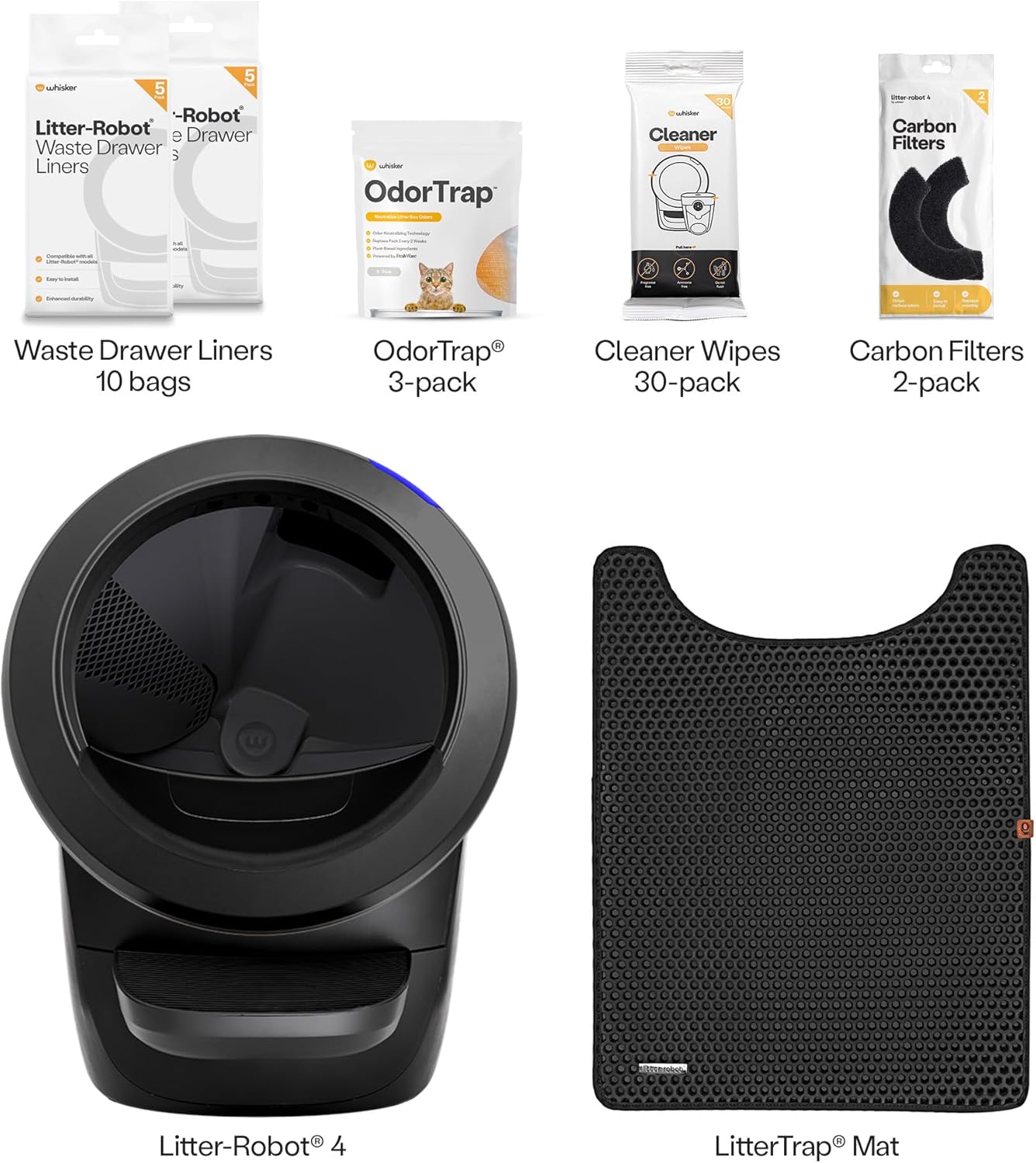
If you’ve started researching self-cleaning litter boxes — the kind that rake, rotate, or sift waste automatically so you don’t have to scoop every day — you’ve probably already hit the first wall: every review assumes your cat is a medium-sized adult in good health. They’re not all that. Maine Coons, Ragdolls, and large domestic mixes regularly tip the scale at 15 to 20-plus pounds. Older cats develop arthritis (joint inflammation that makes high steps genuinely painful) and get picky about enclosed spaces in ways a three-year-old tabby never would. Most buyer guides skip right past these variables. This one doesn’t. Below you’ll find a direct comparison of how the major self-cleaning platforms handle big bodies and aging joints — with real tradeoffs named, the math shown, and a clear decision rule at the end.
Why Size and Entry Height Are Actually Different Problems
It’s tempting to treat “fits a large cat” as a single checkbox. In practice, it splits into at least three separate questions that each unit answers differently:
1. Globe or chamber interior volume. This is the space the cat turns around in once inside. A globe-style box (like the Litter-Robot series) rotates to sift waste into a drawer below — the interior sphere is the cat’s entire usable space. An open-top sifting box gives a cat more psychological room but less containment.
2. Entry opening dimensions. The diameter of the hole a cat steps through, or the width of an open-top entry, determines whether a broad-shouldered 18-pound cat can enter without turning sideways. Owners consistently report this as the single biggest rejection trigger for large cats — more than noise, more than smell.
3. Step height from floor to litter surface. This matters almost exclusively for senior and arthritic cats. A 6-inch step that a young cat clears without thinking becomes a daily pain event for a cat whose elbows and hips ache. PetMD’s editorial overview of feline arthritis notes that reduced jump height and reluctance to use raised surfaces are among the earliest owner-observed signs — meaning your senior cat’s litter box avoidance might be a pain signal, not a preference signal.
Getting any one of these wrong produces the same outcome: the cat refuses the box, you return it within the 30-day window, and you’re back to researching.
Globe-Style Boxes: What “Large Cat Compatible” Actually Means
The Litter-Robot 4 is the most-discussed globe-style unit at its $699 price point, and the large-cat question comes up constantly in owner communities. The published interior globe diameter is approximately 15 inches. Owners with half-Maine-Coon cats in the 14–16 pound range consistently report successful use, with the main caveat being an initial size-concern period — the cat inspects the opening carefully before committing. The Spruce Pets’ 2025 update on self-cleaning litter boxes notes the Litter-Robot 4 as a strong candidate for multi-cat households with larger breeds, specifically citing globe volume as a differentiator versus smaller competitors.
The entry opening (the circular hole the cat steps through) is the more honest limiting factor. Aggregated owner reports suggest cats over roughly 18 pounds — particularly broad-chested males — can find the opening tight. One owner account that surfaces repeatedly in review threads describes an “ancient and huge” cat rejecting a competitor’s enclosed self-cleaning box because of cramped entry geometry, then immediately accepting the Litter-Robot 4 on first presentation. That’s a data point worth taking seriously: entry shape and the feeling of spaciousness inside the globe appear to matter more than raw weight limits for most cats.
The Litter-Robot 3 Connect at $499 uses a slightly smaller globe and a less refined entry opening than the LR4 — the upgrade gap between the two is real for large-cat households, not just a marketing tier.
Where globe-style boxes break down for seniors: The Litter-Robot 4’s entry step sits roughly 10–11 inches off the floor. That’s manageable for a healthy large cat. For a cat with diagnosed or suspected arthritis, it’s a real obstacle. Whisker sells a ramp/step accessory separately — it is not included at purchase. Factor that into your day-one cost.
Open-Top and Non-Globe Alternatives: The Entry-Geometry Argument
The Purobot Max Pro 2 enters this conversation as a genuine counterpoint to globe dominance. A multi-cat owner whose cats refused the Litter-Robot entirely — reportedly turning their backs on it for weeks — describes the same cats beginning to use the Purobot immediately after introduction. The distinguishing factor, based on that owner’s account, appears to be the opening style: the Purobot uses a wider, less enclosed entry geometry that reads as more familiar to cats accustomed to open boxes. For households where globe-style boxes have already failed, this is the unit worth trialing before giving up on automation entirely.
The Robotail 106L carries a remarkable data point: an owner with a 31-pound cat (an extreme outlier, but a real one) reports successful adoption after a three-week transition period running the automatic box in parallel with a manual box. Three weeks is longer than most owners expect and longer than most 30-day return windows allow comfortable experimentation — a timing trap worth flagging. If you’re trialing any box for a very large cat, initiate the transition in week one, not week three.
The UBPET U1 XXXL generates consistent praise from large-cat owners specifically for genuine interior dimensions and a low entry step — owners compare the entry height favorably to a standard covered manual box. For senior cats where step height is the primary concern, this is the unit that comes up most often as a workable solution rather than a compromise.
The MeoWant self-cleaning box earns specific mentions from owners who compare its internal litter pan dimensions directly to a standard manual box. That framing is deliberate reassurance for large-cat owners: if the interior footprint matches what the cat already accepts in a traditional box, resistance to the new unit is lower. Companion Animal Psychology’s 2024 feature on litter box problems notes that novelty itself — new smells, new textures, new shapes — is a primary avoidance trigger, and reducing novelty at every dimension reduces rejection risk.
Senior-Specific Considerations: Litter Type, Box Placement, and Step Height
Senior cats layer complexity. They may have the body of a large cat and the joint mobility of a fragile one simultaneously. Three variables matter most:
Step height. The iHeartCats buyer guide for large cats (2025) explicitly calls out step height as the most under-discussed spec in self-cleaning box reviews. Open-top units generally win here. Among those reviewed, the UBPET XXXL and MeoWant entries are the most frequently cited for genuinely low entry thresholds.
Litter texture. Arthritic cats often develop texture sensitivity in their paws — rough or sharp litter becomes uncomfortable to stand in. One owner account in the review corpus describes using Feline Pine pellet litter in a bedroom box specifically for a senior arthritic cat, chosen because it controls odor without requiring the cat to navigate stairs to a distant box. The pellet format is softer underfoot than clay clumping litter for some cats, though compatibility with automatic raking mechanisms varies — Feline Pine pellets are generally not compatible with self-cleaning units that require clumping litter for the sifting mechanism to function. A manual bedroom box using Feline Pine alongside an automatic unit elsewhere in the home is a legitimate two-box strategy for senior households.
Placement over stairs. If your primary automatic box is on a different floor than where your senior cat spends most of their time, step height at the box itself may matter less than stair navigation. PetMD’s arthritis overview recommends placing litter boxes on each floor a senior cat uses — the automatic box handles the bulk of the household’s scooping load, while a simple manual tray on the senior cat’s primary floor handles daily access without a painful climb.
By the Numbers
| Unit | Interior Space | Entry Style | Approx. Step Height | Included Step Accessory |
|---|---|---|---|---|
| Litter-Robot 4 | ~15” globe diameter | Enclosed globe opening | ~10–11 in. | No — sold separately |
| Litter-Robot 3 Connect | Slightly smaller globe | Enclosed globe opening | ~10 in. | No — sold separately |
| UBPET U1 XXXL | XL open chamber | Wide open-top | Low (est. 3–5 in.) | Yes |
| Purobot Max Pro 2 | Standard chamber | Semi-open, wider aperture | Moderate | Varies by configuration |
| Robotail 106L | Large chamber | Open-top | Moderate | Check current listing |
Frequently Asked Questions
1. What is the realistic maximum cat weight for a Litter-Robot 4 globe? Whisker’s published weight limit is 25 pounds for the Litter-Robot 4. In practice, owners with cats in the 16–20 pound range consistently report comfortable use. Beyond 20 pounds, the entry opening becomes the binding constraint more than the globe volume itself — broad body width, not weight alone, determines fit.
2. Why do some cats refuse globe-style boxes but accept open-top units? Based on aggregated owner reports and the behavioral framing in Companion Animal Psychology’s litter box research, the likely mechanism is enclosed-space aversion amplified by novelty. Globe-style boxes ask a cat to commit fully to an unfamiliar enclosed space before any reward (successful elimination) occurs. Open-top units feel closer to a familiar manual box. Older cats and cats with prior negative enclosed-space experiences show this pattern most strongly.
3. Which self-cleaning boxes have low enough entry steps for senior or arthritic cats? Among units with strong owner-reported data, the UBPET U1 XXXL and MeoWant units are most frequently cited for genuinely low thresholds. Open-top units as a category outperform globe-style units for senior access. No self-cleaning unit fully replicates the zero-step entry of a shallow manual tray placed directly on the floor.
4. Do I need to buy the step accessory separately for most units, or is it included? For Litter-Robot 4 and Litter-Robot 3 Connect, the ramp/step is a separate purchase. The UBPET U1 XXXL includes a step in the base package. Across the broader market, inclusion is inconsistent — verify at purchase, especially for senior-cat households where the step is functional, not optional.
5. How long should I expect a large cat to take before accepting a new automatic box? Modern Cat’s transition guide suggests a two-to-four week parallel-box period as a baseline. For large cats with established preferences or seniors with anxiety, the Robotail 106L owner account (31-pound cat, three-week full transition) is a realistic upper benchmark. Initiate the transition in the first week of your ownership window, not the last. Running both boxes simultaneously — without removing the familiar one — is the single most effective acclimation strategy across owner reports.
The Decision Rule
If your cat is under 18 pounds, healthy, and you want the full app-health-monitoring ecosystem: the Litter-Robot 4 is the defensible choice, step accessory included in your budget from day one.
If your cat has already rejected an enclosed globe-style box, or if you have direct evidence of enclosed-space aversion: trial the Purobot Max Pro 2 before assuming automation won’t work for your household. Entry geometry, not brand loyalty, is the variable.
If step height is your primary concern — senior cat, arthritis confirmed or suspected, reluctance to jump: prioritize the UBPET U1 XXXL or MeoWant for their low entry thresholds, and build a two-box strategy with a manual tray on every floor your cat uses regularly.
If your cat is over 25 pounds: no current self-cleaning unit on the market was designed for that body. The Robotail 106L is the only platform with owner-reported success at that extreme, and it required a dedicated three-week transition with parallel manual access. Manage expectations accordingly.