August 10, 2026 • Margot Vellacourt • 13 min reading time • Prices verified June 4, 2026
Deodorizer Showdown: Which Litter Box Odor Additives and Devices Actually Work

If you’ve ever walked into your own home and thought there it is — that faint but unmistakable signal that a cat lives here — you already know that the litter box hardware is only half the battle. Automatic self-cleaning litter boxes do a genuinely good job of removing solid waste quickly. But “quickly” is not the same as “without a trace.” Ammonia from urine clings to plastic. Waste drawers build up odor between bag changes. And in a multi-cat household — say, three cats sharing one self-cleaning unit — cycle volume is high enough that no lid and no liner alone will keep the room neutral.
That’s where deodorizers come in: powders you mix into litter, pods you install in the machine’s housing, and plug-in devices that use ozone or negative ions to oxidize odor molecules in the surrounding air. The category is crowded and the marketing is vague. This article ranks the main contenders by mechanism, real-world use cases, and honest tradeoffs so you can make one clear purchase decision — not five.
The Core Problem: What’s Actually Making Your Litter Box Smell
Before picking a product, it helps to know which odor source you’re solving. They are not all the same problem.
Source 1: Ammonia from urine. This is the sharp, eye-watering smell. It forms when bacteria break down urea in cat urine within minutes of elimination and saturates porous plastic surfaces. PetMD, in the veterinary-reviewed article “How to Control Litter Box Odor,” identifies ammonia as the primary odor complaint in cat households and notes that neutralization — not masking — is the only durable fix.
Source 2: Volatile sulfur compounds from feces. These are the “garbage” notes. They disperse into the air within seconds and drive whole-room odor spikes in the moments after a cat uses the box.
Source 3: Residual buildup in the waste drawer. Even with weekly bag changes, liquid waste seeps around liners and colonizes the plastic of the drawer itself. This is a slow-burn, low-level smell that owners frequently describe as “something underneath everything” — the smell that persists even after the box looks clean.
Source 4: Litter dust carrying odor particles. In globes and rake-style automatics, every cycle kicks up fine dust that carries ammonia and sulfur compounds and settles on nearby surfaces, walls, and flooring.
Different products attack different sources. Choosing the wrong tool is why so many households end up with a shelf full of half-used deodorizers that “didn’t work.”
Powder Additives: The Inside-the-Box Approach
Powder additives are mixed directly into litter — either at the bottom of the globe or on top of the litter bed — and work through one of two mechanisms: enzymatic breakdown of odor compounds, or baking-soda-style adsorption. The four powders below represent the main mechanism types and use cases available in this format.
NonScents Cat Litter Deodorizer
NonScents is the standout in the enzymatic-neutralization tier. Consistent owner reports note that underdosing is the single most common reason enzyme powders get dismissed as ineffective. The concentration at which the enzyme acts on ammonia compounds requires a meaningful amount of powder per application — not the conservative sprinkle many first-time buyers attempt. Three capfuls rather than one is the threshold that separates “this doesn’t work” from “the odor was gone in five minutes.” That aligns directly with how enzyme-based products actually function: concentration matters, and most label guidance is calibrated for a single-cat household with light use.
NonScents markets explicitly as fragrance-free. The odor-elimination mechanism is chemical breakdown, not scent replacement, which makes it the right call for households where someone has fragrance sensitivities. The Spruce Pets, in its editorial overview “Best Litter Deodorizers for Cats,” identifies fragrance-free enzymatic powders as the recommended starting point for sensitive-household situations.
Best for: Post-elimination ammonia spikes; fragrance-sensitive households. Dosage caveat: Apply at three capfuls minimum per application; underdosing is the most common failure mode.

Nature's
$9.77
In stock on Amazon
Check price on AmazonARM & HAMMER Double Duty Litter Deodorizer
ARM & HAMMER Double Duty sits at the opposite end of the mechanism spectrum: it is a baking soda plus additional odor-neutralizing compound formula rather than a live-enzyme product. It performs reliably in high-volume, multi-animal environments — the kind of throughput stress test most single-cat reviewers cannot replicate. For multi-cat households where sheer cycle volume is the problem, a product with this track record in demanding contexts carries meaningful weight. It is also the most affordable per-ounce of the powders reviewed here.
The tradeoff is reapplication frequency. Baking soda adsorption is passive — it captures odor compounds rather than breaking them down chemically — and in a busy box it saturates faster than an enzyme product would. High-volume households should plan for reapplication every other day rather than weekly.
Note: Some ARM & HAMMER Double Duty formulations contain added fragrance. If fragrance-free is a firm requirement, verify the current label before purchase, as formulations vary by production run.
Best for: High-volume multi-cat households; cost-sensitive buyers. Dosage caveat: Reapplication every one to two days in three-plus cat households; weekly packaging guidance is calibrated for single-cat use.
Nature's
$9.77
In stock on Amazon
Check price on AmazonNature’s Miracle Litter Box Odor Destroyer Powder
Nature’s Miracle Powder earns its place through a specific use case that reveals what distinguishes it from the other enzyme entries: it addresses both the waste drawer smell and urine that has wicked up onto the box’s interior sidewalls. That second detail matters. Sidewall urine is a plastic-absorption problem — Source 3 above — not a litter-bed problem, and the product’s enzyme formula is effective on hard plastic surfaces as well as on the litter bed itself. The Spruce Pets, in its editorial overview “Best Litter Deodorizers for Cats,” specifically calls out Nature’s Miracle’s enzymatic line as well-suited to surface-contact application, not just as a litter additive.
The practical instruction that most users miss: apply some of the powder directly to the waste drawer and sidewall surfaces, not exclusively to the litter. Used only in the litter bed, it behaves like any other enzyme powder. Applied to plastic surfaces, it works on the contamination that no bag change or powder-in-litter approach ever reaches.
Best for: Waste drawer odor; urine wicked onto plastic sidewalls; three-cat households with persistent background smell. Application caveat: Must be applied to box surfaces as well as the litter bed to address Source 3 odor.
NonScents
$12.97
In stock on Amazon
Check price on AmazonFresh Step Odor Shield Charcoal Powder
Fresh Step Charcoal uses adsorption rather than enzymatic activity. Charcoal captures odor compounds passively and continuously but does not break them down chemically. This makes it less effective at handling acute ammonia spikes — the moments immediately after elimination — but a reliable continuous low-level suppressor over days and weeks.
Its best application is households where the litter box is in a visible, design-forward space where odor control needs to be ambient and unobtrusive. Mixed deep into litter rather than applied on top, it works without visible residue. Apartment Therapy, in its guide “How to Make a Small Apartment Not Smell Like Cat,” recommends passive-format odor suppression for open-plan spaces specifically because continuous low-level control matters more than spike management in rooms without a door to close.
Best for: Open-plan living spaces; ambient suppression between litter changes; lower-volume single-cat households. Application caveat: Mix deep into litter; not formulated for acute post-elimination odor events.
NonScents
$12.97
In stock on Amazon
Check price on AmazonOdorTrap Pods: The Inside-the-Machine Passive Solution
OdorTrap Pods for Waste Compartments
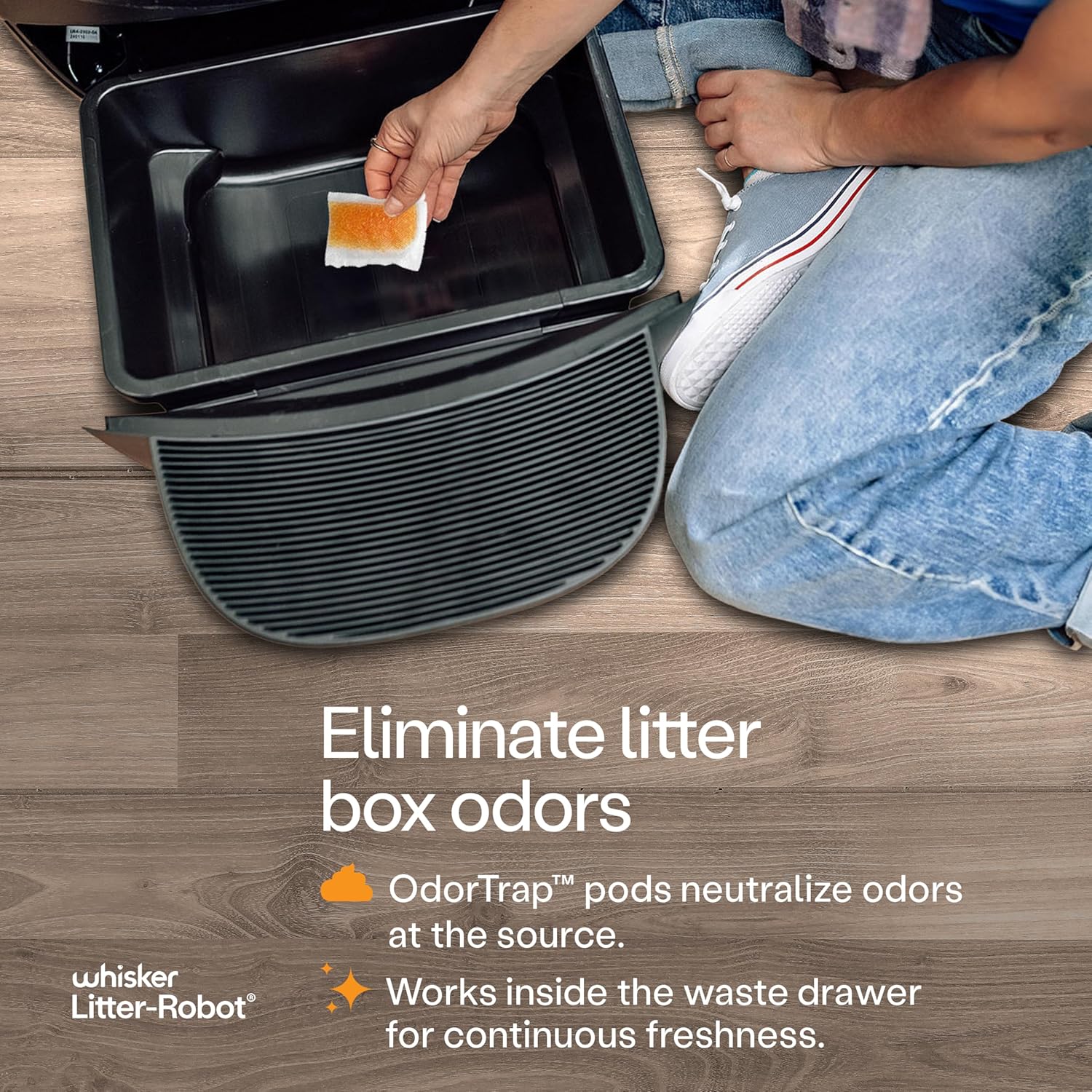
OdorTrap pods are compact deodorizing inserts designed to sit inside the waste compartment or housing of a self-cleaning litter box. They work through slow-release odor-absorbing compounds — no fragrance sprayed, no powder dispersed into litter.
The detail that most validates the product’s mechanism is this: owners with confirmed fragrance sensitivities and respiratory conditions — including asthma — consistently report that OdorTrap pods do not trigger symptoms, while fragrance-based competing pods do. That distinction is not a preference statement. For a user with a reactive airway, a fragrance-masking product presents a genuine health risk, and the fact that OdorTrap passes real-world use by this subset of owners is meaningful evidence that the odor control comes from neutralization rather than scent substitution.
OdorTrap pods have no electrical connection and work passively. They can be placed in the waste drawer or near the waste collection area of multiple automatic litter box brands — fit and placement vary by unit, but effectiveness does not appear to depend on which specific box they are installed in. In a three-cat household, expect to replace pods every two to three weeks rather than the thirty-day interval the packaging suggests.
Apartment Therapy’s small-space cat odor guide recommends passive in-machine odor-neutralizing inserts as a complement to — not a replacement for — litter-level powder additives, noting that different odor sources require different interception points.
Best for: Waste compartment odor between bag changes; fragrance-sensitive and asthma households; passive set-and-forget coverage. Replacement caveat: Every two to three weeks in multi-cat households, not thirty days.
NonScents
$12.97
In stock on Amazon
Check price on AmazonOzone and Negative Ion Devices: The No-Contact Approach
Ambient Ozone and Negative Ion Deodorizer Units
This category generates the most skepticism from first-time buyers and the most surprised testimonials from converts. Ozone-generating devices with negative ion emission oxidize odor molecules in the surrounding air rather than interacting with the litter or the box at all. Ozone (O₃) is an unstable oxygen molecule that breaks down volatile organic compounds — including the sulfur compounds driving post-defecation odor spikes — through chemical oxidation. Negative ions cause airborne particles to clump and drop out of circulation.
The defining use case for this category is the owner who specifically wants zero contact with the litter or the cat’s elimination surface. You place the device outside the box, typically within twelve to eighteen inches, and it works on the ambient air. No powder to dose, no pod to fit into a compartment, no product that a cat can dig up or scatter.
The health question around ozone and cats requires honest handling. High-concentration ozone exposure is a documented respiratory irritant for both humans and animals. Consumer-grade litter box deodorizer devices operate at low concentrations designed to stay below harmful thresholds, but the margin matters. Wirecutter, in its product testing notes for “The Best Litter Boxes,” advises keeping any ozone-generating device at least one foot from the box opening with normal room ventilation maintained. PetMD’s veterinary-reviewed article “How to Control Litter Box Odor” notes that cats with feline asthma or chronic upper respiratory infections have lower tolerance thresholds than healthy cats when exposed to airborne irritants. If a cat in the household has a diagnosed respiratory condition, consult a veterinarian before introducing any ozone-generating device. Negative-ion-only devices — which emit no ozone — are the lower-risk alternative within this format for those households.
Best for: No-contact litter-free application; open-room ambient odor control; households without respiratory-compromised cats. Health caveat: Keep at minimum one foot from the box opening; consult a veterinarian before use in households with cats diagnosed with feline asthma or chronic upper respiratory infection.
OdorTrap
$30.00
In stock on Amazon
Check price on AmazonDecision Framework: If X, Then Y
If your primary complaint is room smell within five minutes of your cat using the box: That is a volatile-compound spike problem. NonScents at full dosing or an ozone/ion device positioned near the box opening is the right tool. OdorTrap pods in the waste compartment are downstream of the event and will not solve this.
If your primary complaint is the waste drawer smell between bag changes: That is a plastic-absorption problem. Nature’s Miracle Powder applied to the waste drawer surfaces — not just the litter bed — addresses it directly. OdorTrap pods in the waste compartment add a second line of defense.
If you have a three-plus cat household and odor is a volume problem: ARM & HAMMER Double Duty paired with weekly waste drawer scrubbing using an enzymatic cleaner handles throughput. Scale reapplication to every other day.
If someone in the household has fragrance sensitivities or respiratory conditions: NonScents (fragrance-free enzyme) and the ozone/ion device (fragrance-free by nature) are your formats. OdorTrap pods have a strong track record with fragrance-sensitive owners; verify the current formulation’s fragrance status before purchasing.
If the litter box is in a visible living area: Fresh Step Charcoal powder blended deep into litter plus an OdorTrap pod handles ambient odor without visible spray bottles or counter-mounted devices. The ozone device can sit beside the unit without being conspicuous.
Frequently Asked Questions
Can litter deodorizer powders be used safely inside a globe-style automatic litter box? Generally yes, with caveats. Fine powders can accumulate in sensor ports and on rubber gaskets of rotating globes. The Spruce Pets, in its litter deodorizer care guidance within “Best Litter Deodorizers for Cats,” recommends applying powder to the litter bed rather than the globe walls and clearing any powder from sensor windows during monthly maintenance using a lint-free cloth. Enzyme powders are inert once dry, which makes them the safest format inside automatics — no ongoing chemical off-gassing near the motor housing.
How often do you need to apply powder additives in a three-cat household? More often than packaging suggests. Single-cat dosing intervals rarely translate. Effective odor control in multi-cat homes typically requires roughly every-other-day application rather than the weekly guidance on most labels. Treat label frequency as the baseline for a single-cat household and scale from there.
Are OdorTrap pods only compatible with one brand of automatic litter box? No. OdorTrap pods have no electrical connection and work passively. They can be placed in the waste drawers or near the collection areas of multiple automatic litter box brands. Fit varies by unit; effectiveness does not appear to depend on which box they are placed in.
Do ozone-generating devices pose any health risk to cats with respiratory issues? Potentially, yes. PetMD’s veterinary-reviewed article “How to Control Litter Box Odor” notes that ozone is a respiratory irritant at elevated concentrations and that cats with feline asthma or chronic upper respiratory infections have lower tolerance thresholds than healthy cats. Consumer-grade devices operate at low concentrations, but cats with diagnosed respiratory conditions warrant a veterinarian consultation before any ozone-generating device is introduced. Negative-ion-only devices are a lower-risk alternative.
What is actually causing the waste drawer to smell even after bag changes? The bag is not the problem — the plastic is. Urine liquid seeps around liner edges and soaks into the drawer’s plastic surfaces, where bacterial colonies establish and continue producing ammonia. Changing the bag removes bulk waste but leaves the contaminated plastic. Enzymatic cleaner applied directly to the drawer surface — not just rinsed — every one to two weeks is the fix. Nature’s Miracle Powder applied inside the drawer between cleanings addresses the interval between deep cleans.
Is there any deodorizer product that is completely fragrance-free and still effective? Yes. NonScents markets explicitly as fragrance-free and enzyme-based — the odor elimination mechanism is chemical breakdown, not scent replacement. The ozone/negative ion device category is fragrance-free by nature. OdorTrap pods are widely reported by fragrance-sensitive owners as non-irritating, though the current formulation should be verified for fragrance status before purchase. Some ARM & HAMMER Double Duty formulations contain added fragrance — verify the current label if fragrance-free is a firm requirement.