August 18, 2026 • Margot Vellacourt • 10 min reading time • Prices verified June 4, 2026
The Litter-Robot 4 Ownership Experience: What Buyers Say After Six Months
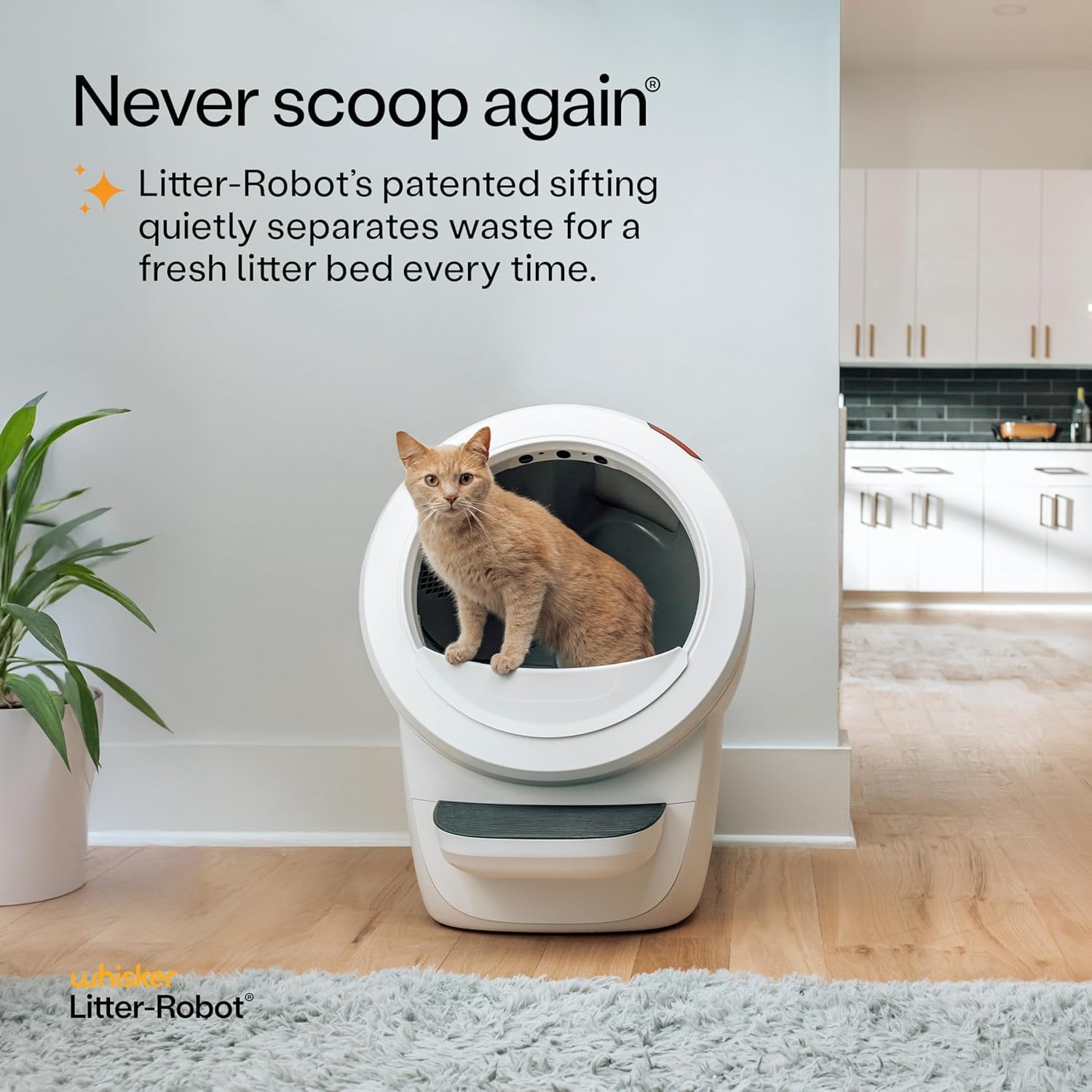
If you’ve ever watched a cat walk past a litter box and thought there has to be a better way to handle this — you already understand the pitch for automatic, self-cleaning litter boxes. The Litter-Robot 4 (think: a matte-gray orb about the size of a beach ball on a base, retailing around $699) is the flagship model from Whisker, and it operates by slowly rotating its globe-shaped chamber after each use, sifting clumped waste into a sealed drawer below while clean litter stays up top. No scooping. A connected app (iOS and Android) logs how often each cat uses the box, tracks weight trends, and sends cleaning reminders. For a lot of households, that combination — zero scooping plus health data — is the reason they’re here. But $699 is a real commitment, and the smarter question isn’t whether the LR4 sounds good on paper. It’s whether the owners who actually bought it still feel that way six months later.
This article synthesizes what those owners are reporting: the things that surprised them, the accessories they reached for after the fact, the comparisons to the older Litter-Robot 3 Connect, and the handful of situations where the LR4 isn’t the right call. If you’re sitting with a browser tab open and a decision to make, here’s what the long-term record looks like.
The Six-Month Pattern: What Owners Keep Coming Back To
The most consistent theme across long-run owner reviews — and this appears repeatedly across verified purchaser pools aggregated by reviewers at The Spruce Pets and Wirecutter — is that the hesitation before purchase was bigger than the disappointment after. Buyers describe months or even years of talking themselves out of the purchase, citing fear of mechanical failure, anxiety about whether their cats would use it, and basic sticker-shock. Then they bought it, and a meaningful share describe the experience with words like “best purchase of the decade” or “genuinely in awe.”
That’s not universal — there are real failure cases and real cat-rejection stories, and we’ll address those — but the pattern is strong enough to be editorially significant. When a product routinely converts skeptics into evangelists who actively convert friends and family, that’s a data point worth naming.
One particular owner pattern stands out: LR3-to-LR4 upgraders. Owners who ran the Litter-Robot 3 Connect for a year or more and then moved to the 4 consistently report that the upgrade justified itself. The LR4’s sealed waste drawer — which uses a liner bag system that crimps and seals before the drawer is pulled for emptying — is cited as the decisive improvement. Where the LR3’s waste drawer required some active odor management, reviewers report the LR4’s sealed bag system effectively eliminates the smell event entirely. One owner specifically notes converting multiple family members after demonstrating this in person.
The waste-outside-the-box problem deserves its own mention. PetMD’s overview of inappropriate elimination notes that stress, box aversion, and cleanliness dissatisfaction are among the most common behavioral drivers of a cat urinating outside the litter box. Among LR4 owners who adopted the unit specifically to address that problem, there are strong anecdotal signals of resolution — including at least one reviewer who describes a particularly finicky cat whose outside-box urination stopped after LR4 adoption. Causation is hard to prove across anecdotes, but the recurrence of this theme is notable.
By the Numbers
| Cats | Estimated drawer emptying frequency |
|---|---|
| 1 cat | Every 10–14 days |
| 2 cats | Every 5–7 days |
| 3–4 cats | Every 3–5 days |
These are community-reported averages. Frequency depends heavily on litter type, cat size, and daily cycle settings. The LR4 app will tell you when the drawer is approaching full via the waste drawer indicator.
Litter, Accessories, and the Real Cost of Ownership
This is where intermediate buyers separate themselves from first-timers: understanding that the $699 unit is the beginning of a cost structure, not the end of it.
Which litter actually works long-term in the globe?
The LR4 requires a clumping litter — the globe rotation relies on clumps holding together so the sifting screen separates waste from clean litter cleanly. What the long-run reviewers add to that spec-sheet requirement is a preference for non-stick, low-dust formulas.
ARM & HAMMER SLIDE Platinum clumping litter has accumulated a specific reputation in LR4 households. One verified reviewer using the LR4 as their test unit explicitly names it “the clear winner” across multiple litters tried, citing the formula’s “Slide” property — a non-stick characteristic that prevents clumps from adhering to the interior globe wall. When clumps stick and dry, they create residue that requires manual scrubbing during monthly cleanings, so a litter that releases cleanly is a legitimate quality-of-life upgrade, not just a marketing claim.
OdorTrap pods: do they actually eliminate smell or just mask it?
The OdorTrap pods (Whisker’s proprietary carbon-and-zeolite odor-trapping inserts that sit in a port on the LR4’s waste drawer) are designed to neutralize odor molecules rather than layer a fragrance over them. Long-run reviewers consistently report they work as described in a well-maintained unit. The loyalty signal is strong: multiple owners report trying third-party alternatives when the pods were out of stock or felt too expensive, only to report that the substitute “did not even compare.” That’s the kind of feedback that reflects a real functional difference rather than brand preference.
The honest caveat: the pods work on the odor that escapes the sealed waste drawer. They are not a substitute for liner hygiene. If the liner bag system isn’t sealing correctly or if waste is accumulating on the drawer walls outside the liner, the pods won’t compensate.
Nature’s Miracle deodorizer powder for the waste drawer
At least one owner flags a persistent urine smell from the waste drawer that regular cleaning didn’t resolve — and reports that Nature’s Miracle Advanced Stain and Odor Eliminator powder solved it. This is consistent with what Apartment Therapy reviewers note more broadly about enzymatic cleaners: they break down urine protein residue that surface wiping misses. If you’re maintaining an LR4 correctly and still getting a smell event when you open the drawer, enzymatic powder treatment of the drawer interior is worth adding to your monthly routine before assuming something is wrong with the unit.
Is the step and fence bundle worth it?
The Litter-Robot step (a staircase that provides an accessible entry ramp) and fence (a higher entry hood that reduces litter scatter) are sold as an add-on bundle. Owner consensus is that the fence earns its price quickly if you have a cat who’s a vigorous digger — litter scatter onto nearby flooring is the most common “I didn’t expect this” complaint from new LR4 owners, and the fence meaningfully reduces it. The step is more household-specific: useful if you have senior cats, very small cats, or cats with joint issues; genuinely unnecessary if your cats are young adults with no mobility limitations.
LR4 vs. LR3: The Honest Comparison for Upgraders
If you’re running an LR3 Connect and trying to decide whether the LR4 justifies a $200+ upgrade, here’s the honest tradeoff frame.
The LR4 adds: a more refined sealed waste drawer with the bag-crimping liner system, improved sensor accuracy (the LR4 uses a weight-based cat detection system rather than the infrared sensor used on some LR3 configurations), OdorTrap pod integration, a revised app with more granular health data, and a quieter cycle motor that owners with light-sleeping cats appreciate.
The LR3 is not obsolete. It handles multi-cat households reliably, Whisker still supports it with replacement parts and liner consumables, and its app integration remains functional. Wirecutter’s automated litter box coverage notes the LR3 Connect as a proven, long-run option even as the LR4 receives the higher placement. If your LR3 is working and your cat count and odor management are under control, the upgrade is a comfort improvement, not a necessity.
For households where the LR3’s waste drawer odor became a friction point — or where the app’s health-data resolution felt limiting — the LR4 upgrade closes those gaps in ways that LR3-to-LR4 switchers consistently confirm.
Frequently Asked Questions
Does the LR4 work for cats over 15 lbs?
The LR4 is rated for cats up to 25 lbs by Whisker’s published specs, and the globe is meaningfully larger than the LR3’s, which was a common complaint for large-breed owners. Owner reports from Maine Coon and large domestic shorthair households are generally positive, though some note that very large cats who like to stretch out fully may still feel cramped. The weight sensor also functions correctly for heavier cats — it’s calibrated to ignore cats sitting on the step before entering rather than triggering a cleaning cycle.
How often do you actually need to empty the waste drawer with two cats?
Based on aggregated owner reports, a two-cat household typically empties the waste drawer every five to seven days. The LR4 app provides a drawer-full indicator that removes the guesswork. Litter type matters here: higher-clumping litters tend to create denser, more compact waste that takes longer to fill the drawer.
Which litter works best in the globe long-term?
ARM & HAMMER SLIDE Platinum clumping litter has the strongest long-run endorsement from verified LR4 owners specifically. Low-dust clumping clay formulas are the general category to stay within; avoid non-clumping, crystal, and lightweight formulas unless you’re specifically running a crystal-tray unit like the PetSafe ScoopFree.
Do the OdorTrap pods actually eliminate waste drawer odor or just mask it?
Owner reports describe genuine odor neutralization rather than masking, with multiple reviewers explicitly noting that third-party substitutes underperformed in direct comparison. The mechanism (carbon and zeolite adsorption) is consistent with how Companion Animal Psychology and PetMD describe effective odor control: trapping odor molecules at the chemical level rather than covering them with a competing scent.
How does the LR4 compare to the LR3 for owners who have used both?
LR3-to-LR4 upgraders consistently rate the sealed waste drawer system and improved app as the primary functional gains. The Spruce Pets’ extended coverage of both units notes the LR4’s health monitoring as a meaningful step up for multi-cat households tracking individual cat behavior over time.
Is the step and fence bundle worth adding?
The fence is worth it for most households with active diggers. The step is worth it for senior or mobility-limited cats. Together they’re a reasonable add-on for a $699 investment — treat them as part of the true acquisition cost when you’re budgeting.
The Decision Frame
If you’re at the decision point: the six-month owner record for the Litter-Robot 4 is genuinely strong, and the hesitation-to-evangelist conversion pattern is hard to dismiss. The units that underperform tend to do so for identifiable reasons — wrong litter type, skipping liner maintenance, or a cat who needs a longer acclimation window than the 30-day return window allows.
If you have two or more cats, manage odor as a genuine daily stress, and want app-based health data that a vet can reference for weight and visit trends — the LR4 is the unit to buy.
If you’re upgrading from an LR3 that’s working fine — wait for a Whisker refurb sale or bundle promotion before pulling the trigger.
If you’re not sure your cats will accept it — that 30-day return window is real, and Whisker honors it. Use it as a trial, not a guarantee. The cat-rejection rate in long-run reviews is lower than the pre-purchase anxiety would suggest, but it’s not zero.