July 20, 2026 • Margot Vellacourt • 11 min reading time • Prices verified June 4, 2026
Litter-Robot 4 vs. Budget Challengers: Is the $699 Price Gap Justified?
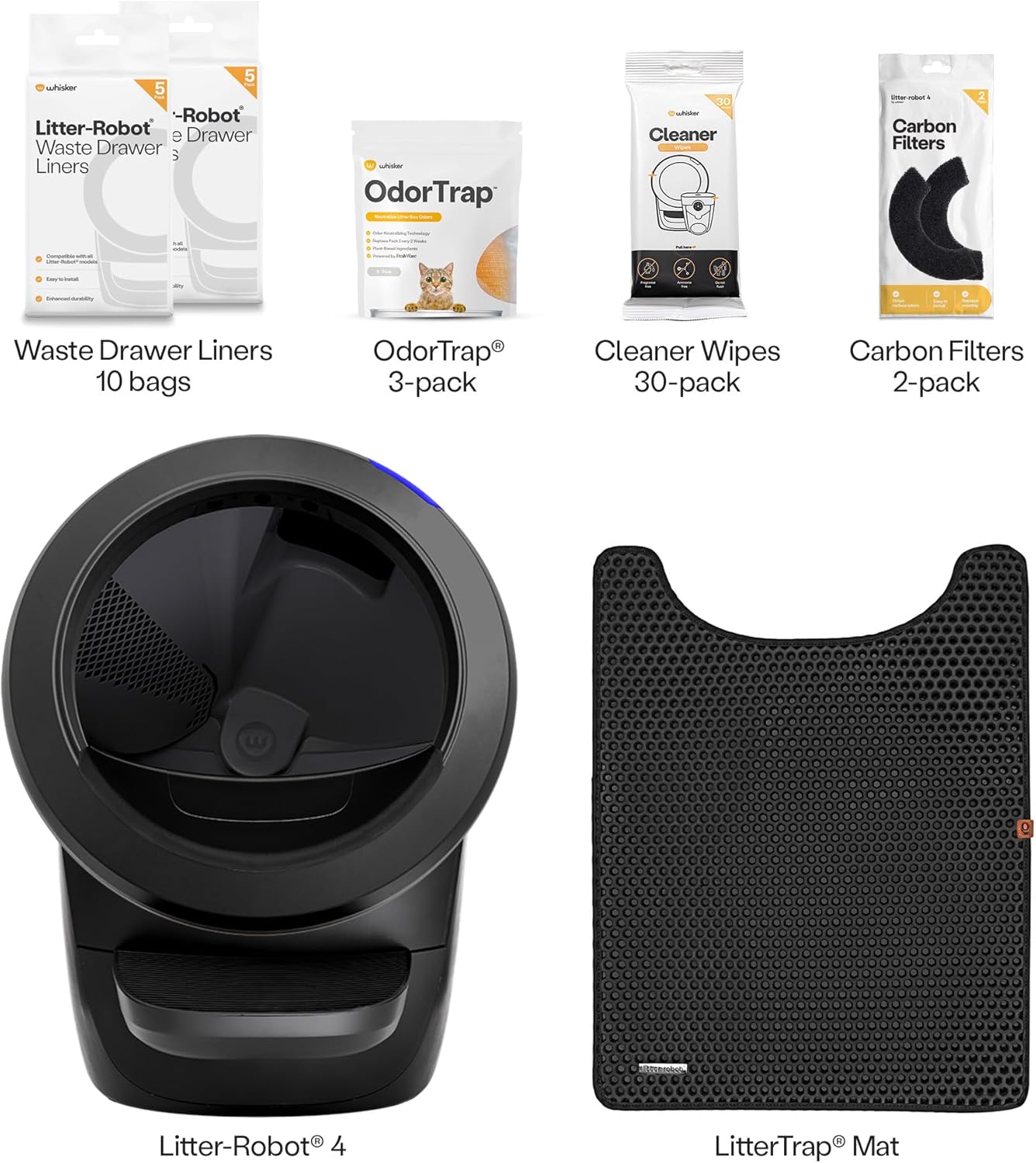
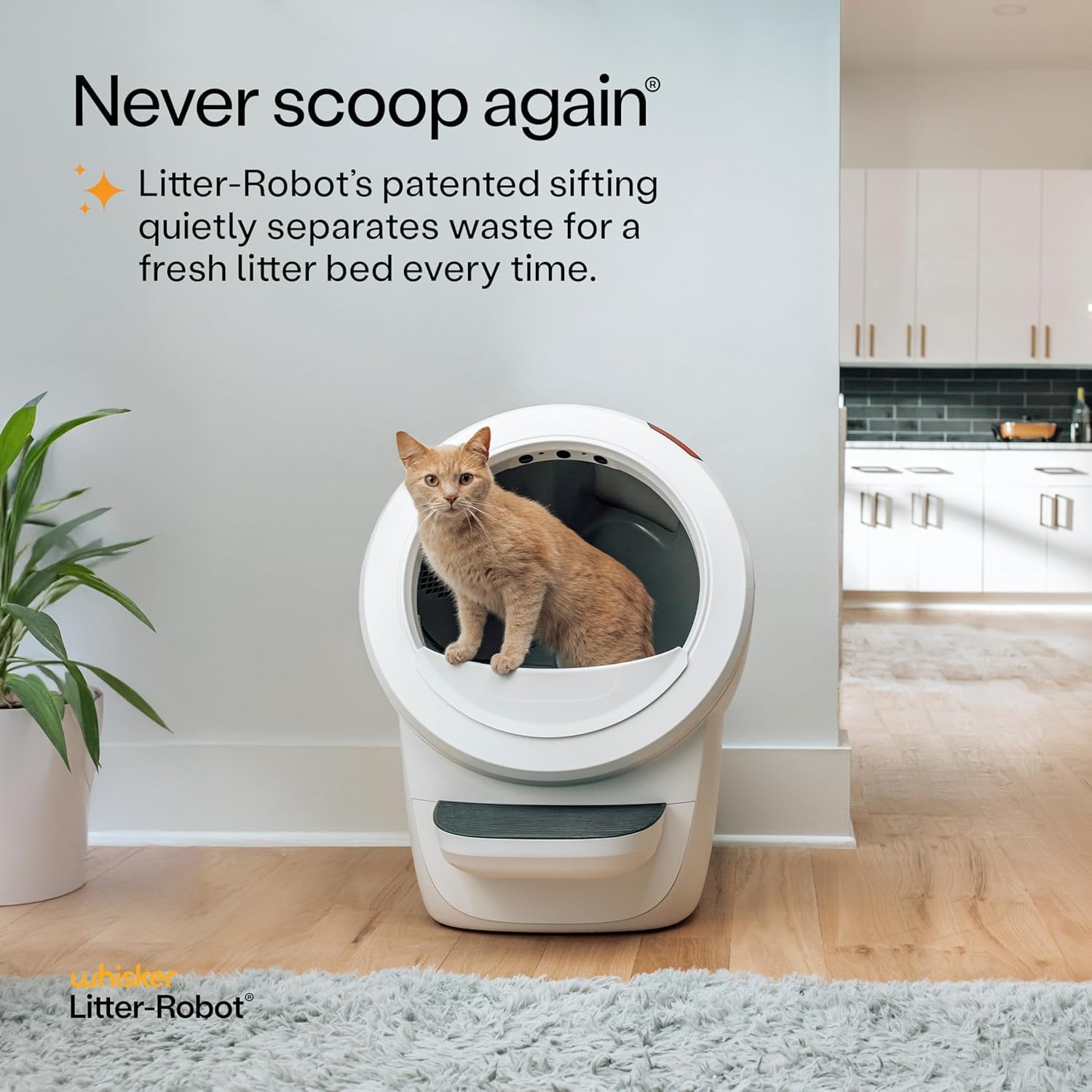
A self-cleaning litter box is exactly what it sounds like: instead of you scooping clumps of used cat litter by hand every day, a motorized mechanism does it for you — rotating a globe, running a rake, or spinning a drum — and deposits the waste into a sealed compartment. The market runs from roughly $80 at the bargain end to $699 for the Litter-Robot 4, which is currently the flagship unit from Whisker and the product most multi-cat owners are comparing everything else against. If you’re reading this, you’ve probably already decided that manual scooping is not the long-term plan. The real question is whether the roughly $500 gap between a budget challenger and the Litter-Robot 4 buys you something real — or whether you’re paying for a logo and a globe shape. This article gives you the comparison with the math shown, including concrete switching stories that run in both directions.
| EDITOR'S PICKLitter-Robot 4 Supply Bundle by… | Mid-tierLitter-Robot 4 by Whisker | Budget pickPetcove Automatic Self Cleaning… | |
|---|---|---|---|
| Odor control | ✓ | — | ✓ |
| Wi-Fi/App | — | — | ✓ |
| Warranty | — | ✓ | — |
| Bundled items | ✓ | — | — |
| Filter included | ✓ | — | — |
| Litter type | — | Clumping | — |
| Price | $749.00 | $699.00 | $359.99 |
| See on Amazon → | See on Amazon → | See on Amazon → |
What You’re Actually Comparing at Each Price Point
Before the line-by-line breakdown, it helps to frame what each tier is selling.
The Premium Tier: Litter-Robot 4 (~$699)
Litter-Robot
$749.00
In stock on Amazon
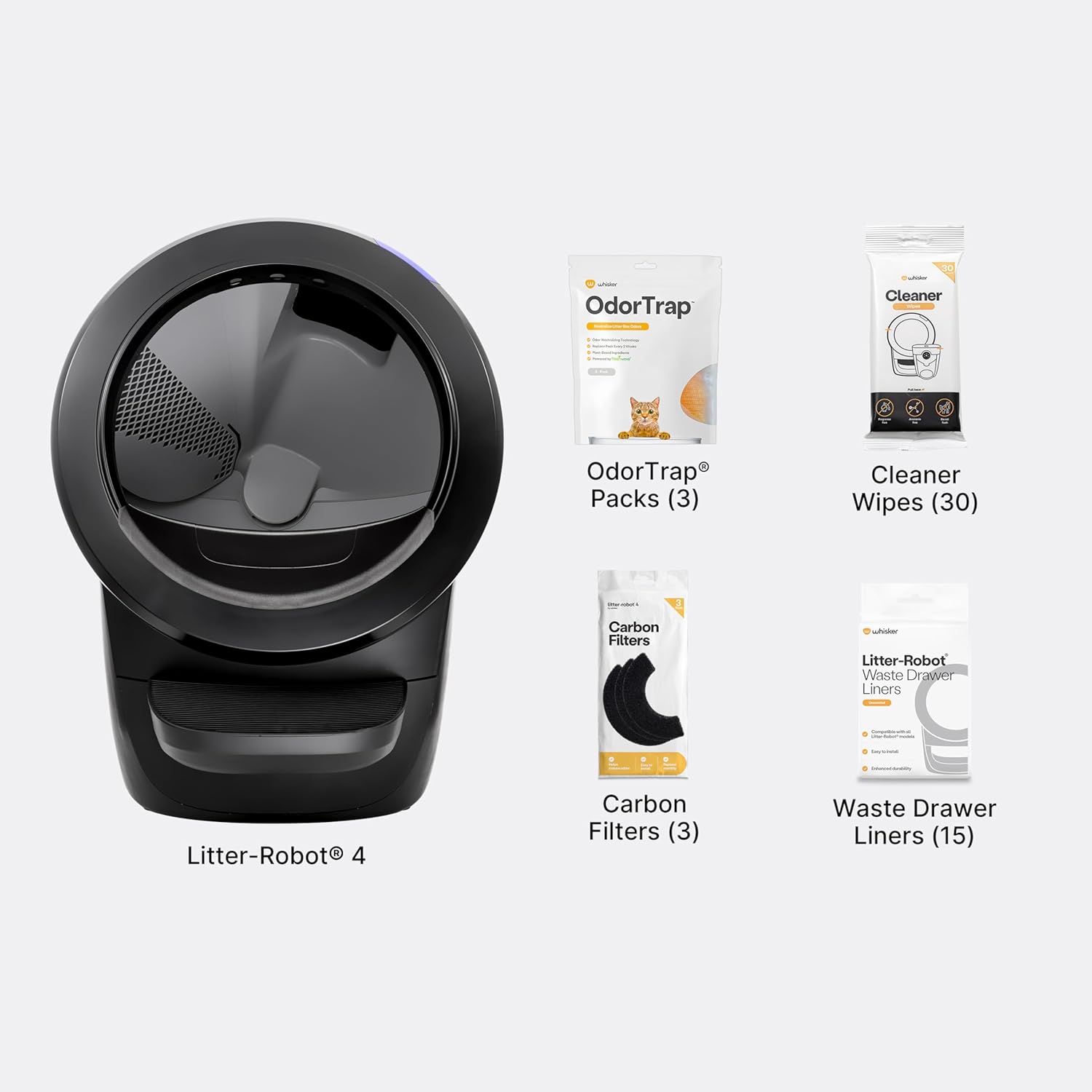
Check price on AmazonThe Litter-Robot 4 is selling an ecosystem: a rotating-globe design with a weighted sensor that tracks which cat used the box and how much they weigh per visit, an OdorTrap pod system that actively manages odor inside the waste drawer, an app that logs visit data over time, and Whisker’s customer support infrastructure. The Spruce Pets, in their roundup “Best Self-Cleaning Litter Boxes of 2025,” consistently identifies the LR4 as the strongest option for households with three or more cats — in part because the waste drawer is large enough that owners with six cats report going a week or more between drawer empties.
The LR4 is not a perfect machine. Its globe-style interior can accumulate waste residue in awkward corners during high-volume cycling, and at $699 the sticker price is a genuine obstacle for households where a cat unit that costs more than a month’s groceries requires justification. But for what it is — a health-monitoring, odor-controlling, high-capacity automated system — nothing else in the market matches the whole package.
Litter-Robot
$749.00
In stock on Amazon
Check price on AmazonThe Mid-Tier Challengers: PETKIT PURA X and PURA MAX (~$169–$199)
Litter-Robot
$699.00
In stock on Amazon
Check price on AmazonMid-tier units — primarily the PETKIT PURA X and PETKIT PURA MAX — are selling a reasonable subset of premium features for roughly a quarter of the price. You get app connectivity, weight monitoring with caveats (more on those below), and a self-cleaning cycle. The build quality is good enough that at least one documented owner switched away from a Litter-Robot 4 specifically to run two PETKIT-ecosystem units, citing cleaner internal surfaces and materials feel as the deciding factors.
PETKIT’s app tracks visit counts and weights, but multi-cat disambiguation is weaker at this tier — the system struggles to reliably assign visits to specific cat profiles when two cats weigh similar amounts. For a two-cat household where both cats are within a pound of each other, the health data becomes less actionable. Odor control relies on a carbon filter rather than an active sealed system, which is functional but less aggressive than the OdorTrap approach.
The PETKIT tier is the most honest mid-range choice if your budget ceiling is firm and you have one or two healthy cats whose weights are meaningfully different from each other.
Litter-Robot
$699.00
In stock on Amazon
Check price on AmazonThe Budget Tier: Sub-$150 Units
Petcove
$359.99
In stock on Amazon
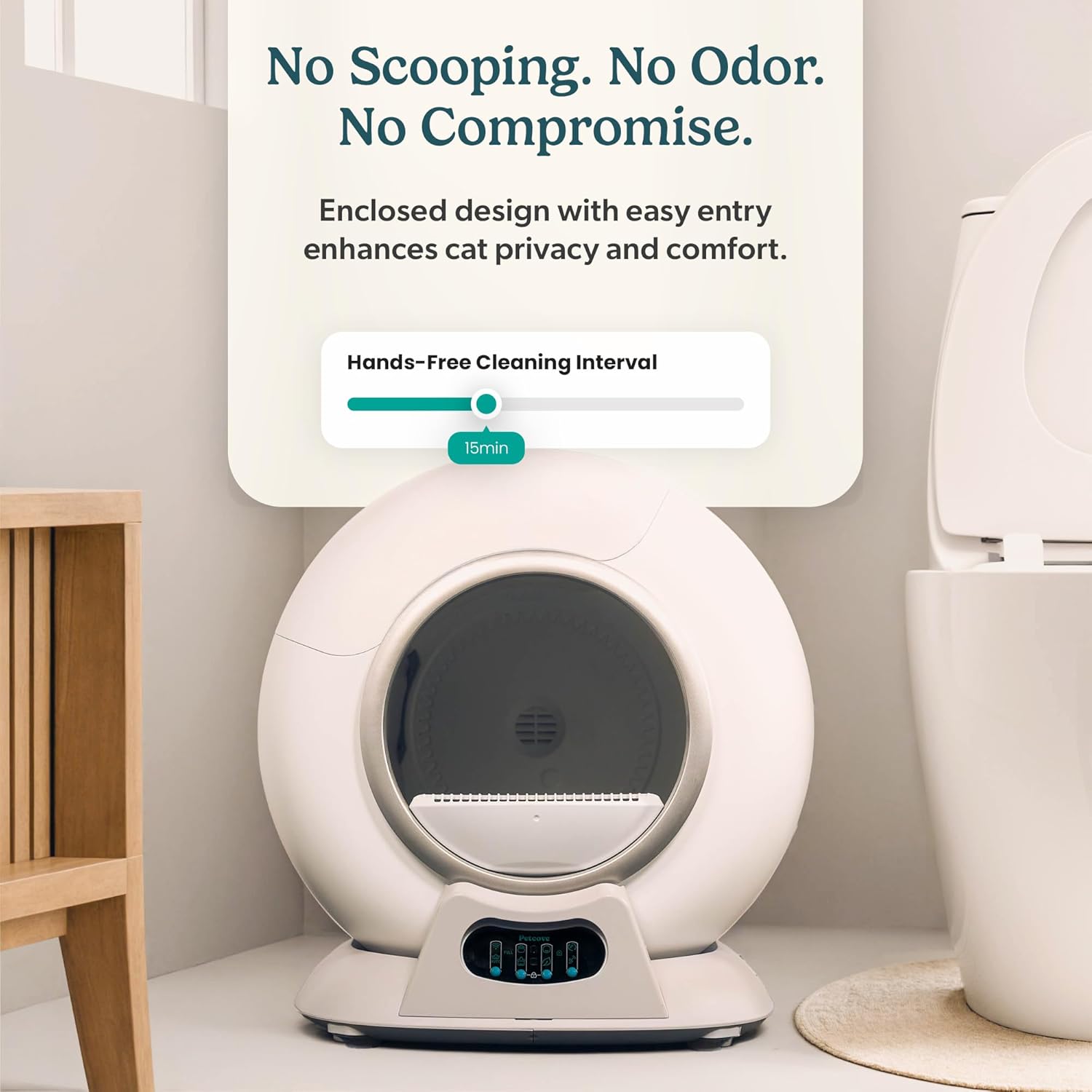
Check price on AmazonThe budget tier — brands including Cumrige, Fumoi, PetPivot, Petcove, and Mintakawa — is selling the automation itself at the lowest possible entry price. These units do clean themselves. Owners across aggregated reviews report that cats adapt faster than expected, and cleaning cycle noise is generally described as quiet and manageable. What you give up is ecosystem depth, build durability, and support infrastructure.
Three failure patterns repeat across budget-tier owner feedback. Litter accumulating in wheel channels — particularly visible in Mintakawa owner accounts — can require manual clearing and eventually degrades the motor. Mid-cycle stalls requiring manual intervention show up consistently in PetPivot feedback. App connectivity hiccups — the unit cleans but the app doesn’t register it, or vice versa — are nearly universal across budget app-connected units. None of these are dealbreakers at $100, but they shift the maintenance burden back to you in ways that erode the core value proposition of a self-cleaning system.
iHeartCats, in their feature “Do Automatic Litter Boxes Actually Save Time?”, notes that the time savings from automation are substantially reduced when owners must regularly intervene to clear jams, reset connectivity, or replace units — a pattern more common at the budget tier than manufacturers’ product pages acknowledge.
Petcove
$359.99
In stock on Amazon
Check price on AmazonThe Switching Stories: Both Directions Matter
One of the most useful data points in this comparison is that the switching stories run in both directions — and understanding why tells you more than a spec sheet.
The switch away from the LR4: One owner with a documented multi-cat household moved from the Litter-Robot 4 to two PETKIT-ecosystem units and has stayed there. Their stated reason was not price — it was materials and cleanliness. They found the internal surfaces of the PETKIT unit stayed cleaner between cycles and that the physical build felt less prone to waste residue accumulating in hard-to-reach areas. This is a legitimate concern for owners managing four or more cats. When a globe-style mechanism is cycling 15 or more times a day, the interior sanitation story matters as much as the automation story. If you’re in a high-volume household and you’ve noticed your globe’s interior getting coated between deep cleans, this switching story is directly relevant to you.
The switch away from a budget unit: A CATLINK Open-X owner switched specifically because their prior unit — a globe-style design comparable in mechanism to older globe units on the market — kept throwing over-torque error codes. The over-torque error occurs when litter clumps or debris catch the motor mid-rotation. The CATLINK Open-X, which uses an open-top drum design rather than an enclosed globe, eliminated the error code problem for this owner. Open-top drum-style units generally handle high-volume households and chunky clumping litters more gracefully than enclosed globes because there is less mechanical constraint on the rotation path.
The cost of budget unit failure: If a budget unit fails at month 14 and the 90-day warranty has expired, you are buying again. On a five-year horizon, two budget unit replacements close the price gap with a mid-tier unit faster than the sticker prices suggest. Before buying any budget unit, search the brand name alongside “warranty claim” in owner forums. If you cannot find evidence of successful warranty fulfillment from other owners, treat the purchase as disposable rather than infrastructure.
True Cost of Ownership: The Math Shown
The sticker price is the least interesting number in this comparison. The Spruce Pets, in “Best Self-Cleaning Litter Boxes of 2025,” and iHeartCats, in “Do Automatic Litter Boxes Actually Save Time?”, have both noted that recurring consumables — replacement liners, carbon filters, OdorTrap pods, and compatible litter — represent a significant ongoing cost that changes the five-year calculus substantially.
LR4 consumables over 12 months (single-to-two cat household, estimated):
- OdorTrap pods: approximately $5–6 per month → approximately $65 per year
- Waste drawer liners: approximately $15–20 per quarter → approximately $65 per year
- Compatible clumping litter: no proprietary litter lock-in; standard clumping litters work
- Consumables subtotal: approximately $130 per year
PETKIT PURA X consumables over 12 months:
- Carbon filter replacements: approximately $3–4 per month → approximately $40 per year
- Compatible litter: tofu-based or fine clumping recommended, which can cost more than standard clumping
- Supplemental deodorizer spray if odor control is insufficient: approximately $30 per year
- Consumables subtotal: approximately $70–90 per year
Budget unit consumables over 12 months:
- Filters if included: approximately $20–30 per year
- Replacement parts if motor stalls: variable, and often unavailable after 18 months
- Potential unit replacement: if the unit fails outside warranty, full replacement cost applies
On a pure five-year cost-of-ownership basis, the LR4’s consumable overhead is higher than the mid-tier, but the unit replacement risk is dramatically lower. Factor in one budget unit replacement in year two and the five-year delta between budget and mid-tier shrinks to under $100. Factor in the value of time spent clearing jams and resetting connectivity and the budget tier’s advantage erodes further.
App Health Monitoring: Is the Data Actually Useful?
Apartment Therapy, in the piece “I Tried the Litter-Robot 4 for Three Months,” surfaced this question most clearly: the Whisker app produces per-cat weight logs and visit-frequency charts that owners describe as genuinely informative. Multi-cat households report that the LR4’s SmartScale can distinguish between cats of meaningfully different weights — typically cats more than one to two pounds apart — and log each visit to the correct profile with reasonable accuracy.
PetMD, in their guide “How to Tell If Your Cat Is Healthy by Monitoring Litter Box Habits,” notes that consistent litter box monitoring is one of the clearest early indicators of feline health changes — urinary issues, kidney stress, diabetes onset — and that owners who track visit frequency and weight trends are better positioned to catch problems early. The LR4’s health monitoring app is the only system in this comparison that produces data granular enough to show a veterinarian meaningful trends over a six-to-twelve month period.
PETKIT’s app is functional but weaker on multi-cat ID, as noted above. Budget units with apps essentially offer connectivity without insight: you can see that the box cleaned and sometimes when, but weight data is either absent or unreliable.
The practical implication: if health monitoring is your primary driver — you have a cat with a history of FLUTD, kidney disease, or unexplained weight fluctuation — the LR4’s data is the only tier that produces something a vet can engage with seriously.
Frequently Asked Questions
Will a large or Maine Coon-sized cat fit in a budget globe-style unit?
Open-top drum-style units generally accommodate large cats better than globe-style enclosures. The Litter-Robot 4 has a manufacturer-rated entry port of 15.75 inches, which accommodates most Maine Coons — reviewers with large-breed cats confirm this — but very large males at 18 or more pounds may feel cramped. Budget globe-style units typically have smaller entry ports than the LR4. If your cat is large, open-top drum units are worth prioritizing regardless of brand tier.
Do cheaper units’ apps give the same weight-monitoring data as the Litter-Robot 4 app?
No. PETKIT’s app is functional but weaker on multi-cat identity assignment. Budget units with apps rarely produce reliable weight data. The LR4’s SmartScale system is meaningfully more sophisticated, and the Whisker app’s health trend visualization is the only one in this comparison that owners describe as useful at a veterinary appointment.
Can I run a budget unit alongside a Litter-Robot 4 in a high-traffic home?
Yes, and this is a legitimate strategy for households with five or more cats. Several high-count multi-cat owners run a primary LR4 for health monitoring and one or two budget units as overflow capacity. The LR4 captures the data; the budget units handle volume. The main risk is that a mid-cycle budget unit stall during a busy period creates a litter box avoidance situation — cats are sensitive to box cleanliness — so confirm a budget unit’s reliability before depending on it as overflow.
Does the OdorTrap system make a meaningful difference over a deodorizer additive?
Owners who have used both describe a meaningful difference, particularly for urine odor in the waste drawer. Deodorizer additives — crystals, powders, sprays mixed into litter — address odor in the litter bed itself. The OdorTrap pod is positioned at the waste drawer, which is where fermented urine odor concentrates between empties. Several LR4 owners who identify as sensitive to smells, including those managing asthma in the household, specifically credit the OdorTrap system for making a previously-difficult-to-place unit viable in a living space. Additives are useful but address a different part of the odor chain.
The Decision Rule
If you have three or more cats, a cat with a monitored health condition, or a living situation where odor control is non-negotiable — the Litter-Robot 4’s price gap is justified. The ecosystem holds together, the consumables are predictable, and the health data is the only tier that produces something actionable at a veterinary appointment.
If you have one or two healthy cats, a $699 ceiling feels real, and you are willing to trade app sophistication for reasonable hardware quality, the PETKIT PURA X represents the most honest mid-tier choice — with the documented caveat that multi-cat weight disambiguation is its weak point.
If you are testing automation for the first time, have a single cat, and genuinely do not know whether you will stick with a self-cleaning system, a budget unit at $100–$130 is a reasonable experiment — with eyes open that you may be buying again in 18 months. Treat it as a trial, not long-term infrastructure.
The switching stories in both directions confirm what the specs suggest: there is no universal answer, but there is a right answer for your specific cat count, health monitoring needs, and tolerance for maintenance friction. Know which of those drives your decision and the tier selection follows naturally.