July 23, 2026 • Margot Vellacourt • 11 min reading time • Prices verified June 4, 2026
Open-Top vs. Enclosed Globe: Which Entry Style Do Cats Actually Prefer
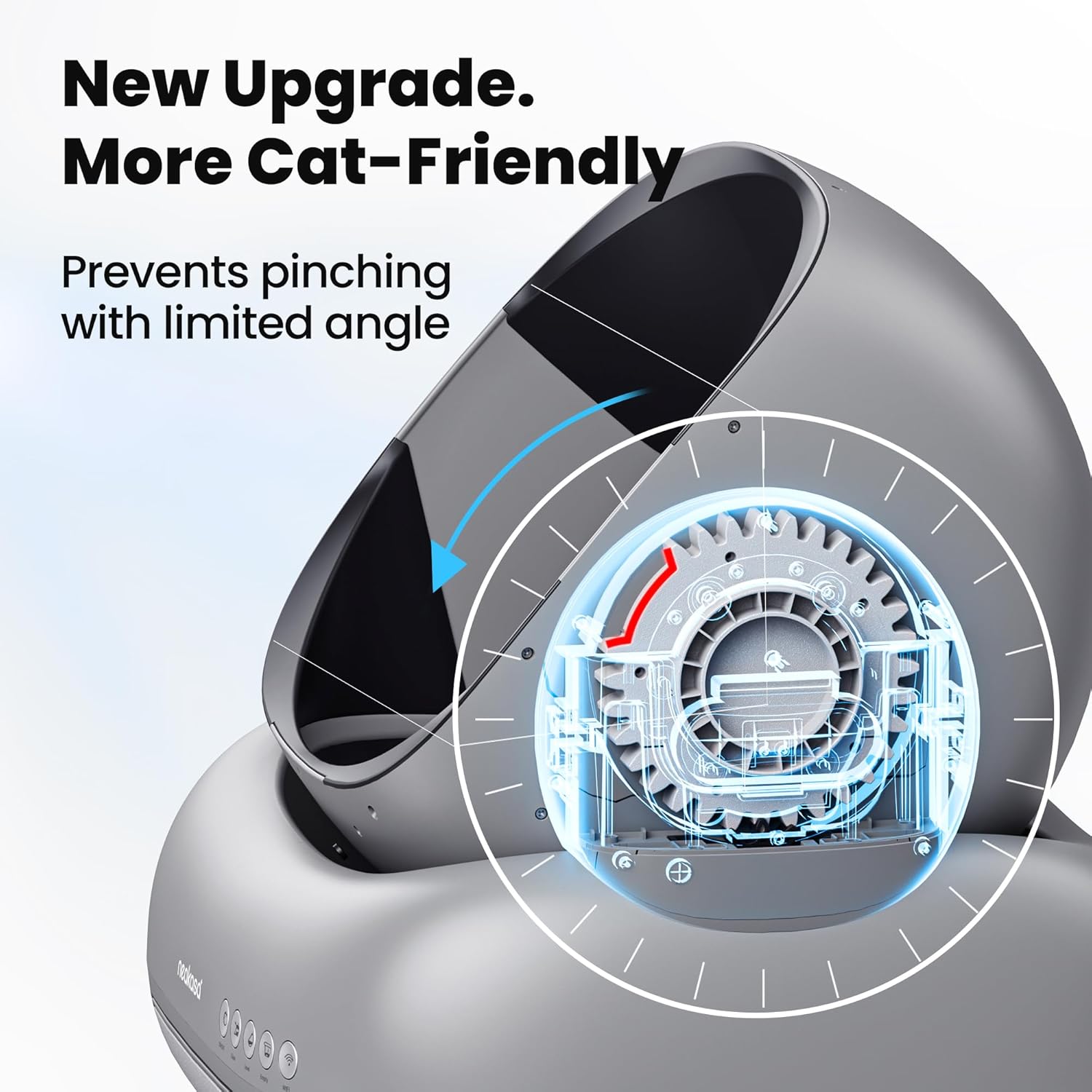
If you’ve been shopping for a self-cleaning litter box — the kind that scoops, rakes, or rotates so you don’t have to — you’ve probably noticed that they split into two very different shapes. One looks like a globe or drum: your cat walks through a small portal into a fully enclosed chamber, the whole thing rotates when cleaning time comes, and waste gets deposited into a sealed drawer below. The other style is open at the top, like a traditional litter box with tall walls and an automated rake or auger that sweeps through after your cat exits. Both handle the scooping for you. But one of them has a dirty secret hiding in a few hundred one-star reviews: a meaningful percentage of cats simply refuse to use it. Before you spend $200 to $700 on hardware, it’s worth knowing which design is more likely to earn your cat’s actual approval — and which one might end up sitting unused in a corner while your cat pointedly uses the bathroom floor instead.
| EDITOR'S PICKNeakasa M1 Plus Open-Top Self-C… | Mid-tierSelf Cleaning Cat Litter Box | Budget pickUPFAS Automatic Cat Litter Box… | |
|---|---|---|---|
| Open-Top Design | ✓ | ✓ | — |
| Color | — | Grey white | Grey |
| App Control | — | — | ✓ |
| Weight Monitor | — | — | ✓ |
| Bags Included | ✓ | — | — |
| Price | $449.99 | $139.99 | $127.49 |
| See on Amazon → | See on Amazon → | See on Amazon → |
The Core Tradeoff in Plain Terms
The enclosed globe earns its reputation through odor containment. When the chamber is sealed and the waste drops into a carbon-filtered drawer, the smell is genuinely controlled. Units like the Litter-Robot 4 and the PETKIT PURA X are specifically engineered around this advantage — the Litter-Robot 4’s OdorTrap pod system and the PETKIT PURA X’s AIRSIFT multi-layer filtration are both designed to address the odor problem at the hardware level rather than relying on litter chemistry alone. App-based health tracking, weight monitoring, and smart-home integration also tend to cluster at the globe tier, because the hardware complexity justifies the ecosystem investment.
But the enclosed entry creates two specific friction points for cats. First, the opening is physically small — typically 6 to 8 inches in diameter — which is manageable for a 9-pound tabby and genuinely stressful for a 15-pound Maine Coon. Second, and more behaviorally significant: cats with any anxiety around enclosed spaces treat the globe like a trap. Companion Animal Psychology’s research overview “Cats and Litter Box Problems” identifies perceived entrapment as one of the primary behavioral triggers for elimination outside the box — not a quirk, but a documented pattern. Reviewers across multiple globe-style units describe cats that used the box comfortably for weeks, then abruptly stopped. The switch in several accounts appeared linked to one cat surprising another inside the chamber. Once that anxiety association is established, it’s very hard to reverse.
Open-top designs — including the UBPET U01 XXXL, MeoWant 106L, Neakasa M1 Pro, PetPivot, and HHOLOVE — sidestep this entirely. There’s no portal to negotiate, no enclosed space to feel trapped inside, and the cleaning mechanism (typically a spiral auger or rotating rake) operates in open air. The Spruce Pets’ buyer guide “Best Self-Cleaning Litter Boxes” consistently notes that open-top units see higher first-use acceptance rates, particularly in multi-cat households where cats observe each other using the box before attempting it themselves. The tradeoff is unambiguous: odor control is meaningfully weaker, and owners compensate with deodorizer powders, charcoal toppers, or external ionizers placed nearby.
How the Two Designs Compare Across Three Ownership Tiers
The right choice isn’t purely about hardware capability — it’s about matching design tradeoffs to your household’s specific constraints. The three sections below walk through budget, mid-tier, and premium-tier considerations in turn.
Budget and Entry-Level Ownership
UPFAS
$127.49
In stock on Amazon
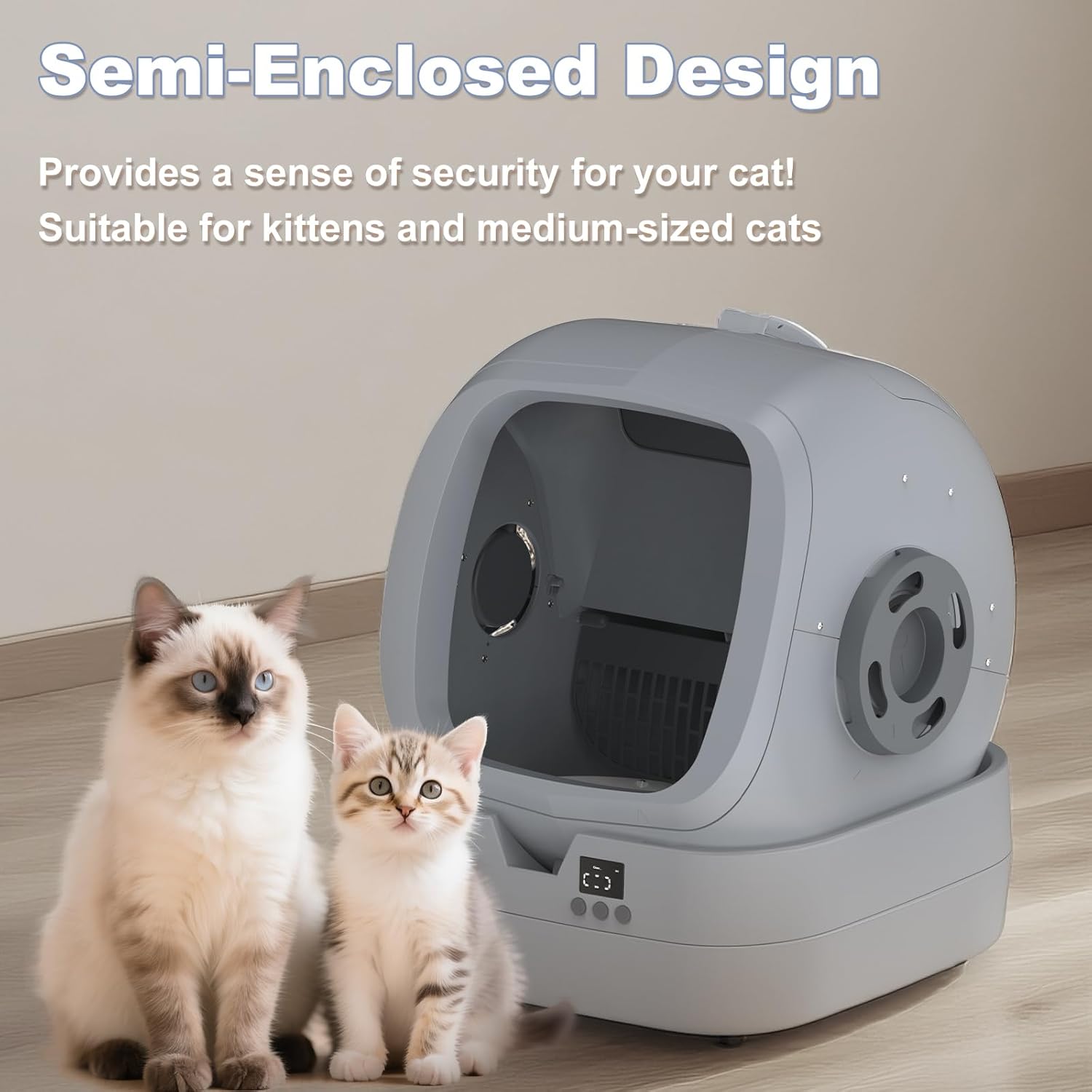
Check price on AmazonAt the entry level, open-top designs dominate on value per square inch of usable interior space. Units in the $130–$220 range — the Oneisall, Greesum, and base-tier MeoWant models — offer large interior volumes at prices that are substantially lower than any enclosed globe. For a single-cat household where the box lives in a utility room or bathroom with ventilation, the odor disadvantage shrinks considerably, and the acceptance advantage over globe designs is just as real at this price point as it is higher up.
The budget caveat worth naming: sensor quality at this tier is inconsistent. Oneisall owners in aggregated review threads report that the infrared sensors can trigger cleaning cycles when a cat walks past the box rather than into it — wasting cycles, wearing the mechanism faster, and occasionally flinging litter if a cat is mid-entry. Units that offer an app-based sensitivity adjustment give you a real tool to address this; units that don’t are betting on factory defaults being right for your floor plan and cat size. PetMD’s guidance on litter box placement and hygiene emphasizes that a cat that gets startled during elimination will associate the location — not the machine — with danger, which means a hair-trigger sensor is a behavioral risk, not just an annoyance.
If budget is the primary constraint and your cat is relaxed and average-sized, an entry-level open-top is the lower-risk starting point compared to an enclosed globe at the same price tier.
UPFAS
$127.49
In stock on Amazon
Check price on AmazonMid-Tier: Where Most Buyers Land
Self
$139.99
In stock on Amazon
Check price on AmazonThe $220–$450 range is where the comparison becomes genuinely competitive. This tier includes larger-format open-top units like the UBPET U01 XXXL and MeoWant 106L — both specifically designed for multi-cat households and larger breeds — alongside enclosed globe models like the PETKIT PURA MAX and older Litter-Robot 3 Connect units available refurbished.
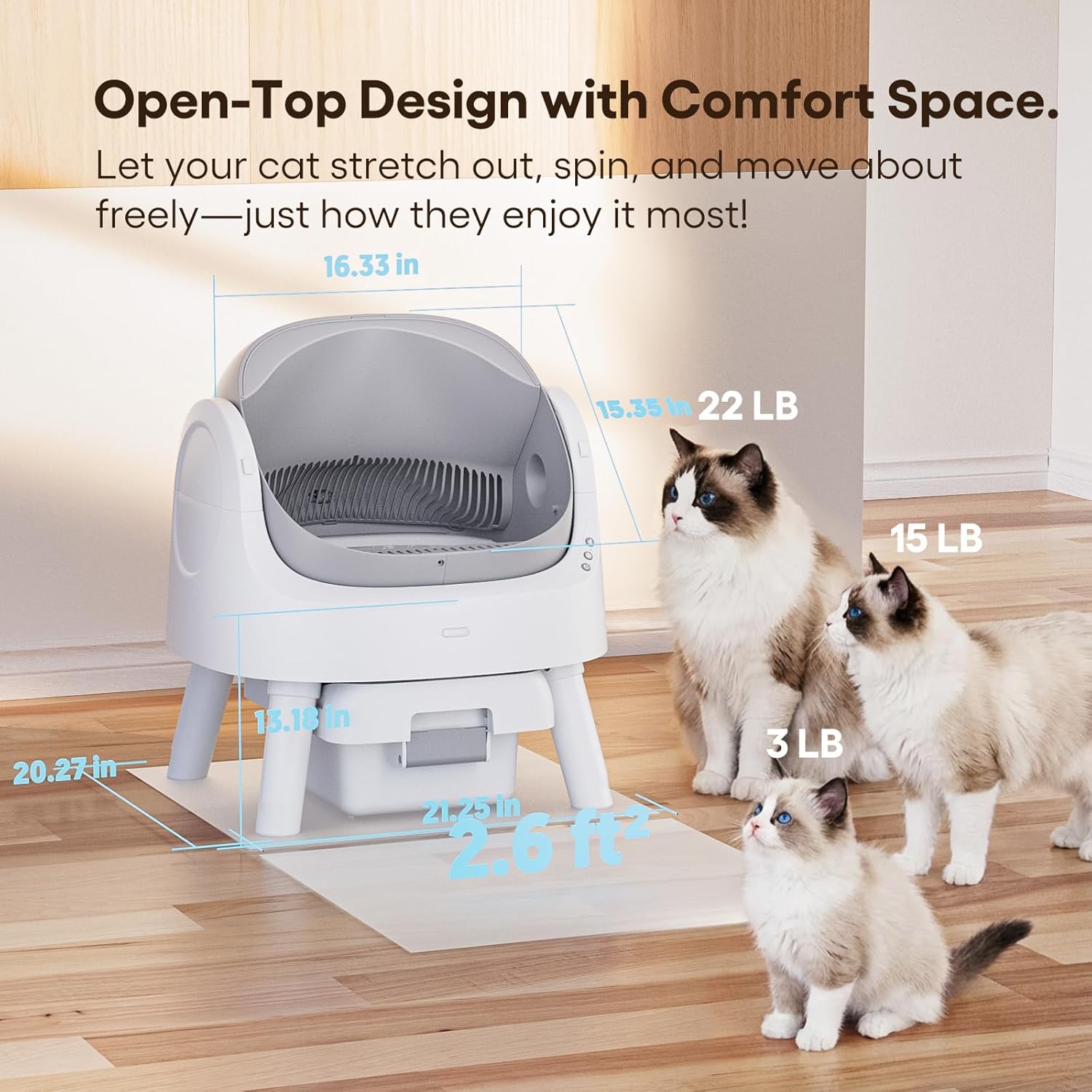
Cat size becomes a hard decision variable here. The UBPET U01 XXXL and MeoWant 106L are frequently cited in owner accounts specifically because of their interior volume — cats at 13 to 18 pounds can turn around freely, which Modern Cat’s guidance on litter box selection identifies as the minimum functional requirement: a cat should be able to enter, turn 360 degrees, and exit without touching the walls. At mid-tier globe prices, the chamber volume is not always sufficient for cats above 15 pounds, even when manufacturer weight ratings suggest otherwise. Whisker’s published specs for the Litter-Robot 3 rate it for cats up to 15 pounds; reviewer accounts and PetMD’s litter box sizing guidance both suggest that a 15-pound cat in a mid-tier globe is getting tight in practice, not just in theory.
For multi-cat households at this tier, the open-top category also wins on simultaneous access. An enclosed globe is a single-occupancy portal by design. An XXXL open-top has enough interior volume that a confident cat will enter while another finishes, which matters more in a four-cat household than a two-cat one.
The mid-tier is where sensor performance in open-top units meaningfully separates better-engineered products from the rest. The MeoWant 106L’s app-based sensitivity dial appears consistently in owner accounts as a practical differentiator — owners report a 2-to-3-day calibration period after which false positives drop sharply. Units without that adjustment require trial-and-error placement to minimize false triggers.
Self
$139.99
In stock on Amazon
Check price on AmazonPremium-Tier: When the Globe Earns Its Price
Neakasa
$449.99
In stock on Amazon
Check price on AmazonAbove $450 — and particularly at the $600–$700 tier occupied by the Litter-Robot 4 and the current PETKIT PURA X — the enclosed globe design makes its strongest case. The hardware at this tier is genuinely differentiated: the Litter-Robot 4’s weight-based health monitoring, dual-cat detection, and OdorTrap pod filtration system; the PETKIT PURA X’s AIRSIFT multi-layer odor control and integrated app ecosystem. These are not features available on open-top units at any price, and for owners who want health trend data across multiple cats — flagging weight loss, tracking usage frequency, surfacing early indicators of urinary issues — the premium globe tier is currently the only hardware category delivering it.
Apartment Therapy’s coverage of automatic litter boxes in small-space living notes that the odor advantage of enclosed globe units is most meaningful in studio or one-bedroom apartments where the litter box necessarily shares a living area. If your box lives in a dedicated utility space with ventilation, the odor gap between a quality open-top and a sealed globe is manageable. If it sits six feet from your couch, it is not.
The acceptance risk at premium-tier globe prices is real, and it should factor into your decision honestly. The Spruce Pets’ “Best Self-Cleaning Litter Boxes” guide notes that globe-style units carry a meaningful cat-refusal risk — particularly for anxious cats, multi-cat households where inter-cat dynamics create surprise encounters inside the chamber, and cats above 14 pounds for whom the entry portal is physically cramped. At $699, the return window is your primary safety net. Use it deliberately: introduce the unit in an accessible, low-traffic location, run it in “off” mode for 48 hours to let the cat investigate without triggering motor sounds, then enable cleaning cycles gradually. Companion Animal Psychology’s research on litter box avoidance is clear that associations form quickly and persist — a single frightening experience during the introduction period can close the adoption window permanently for that cat.
Neakasa
$449.99
In stock on Amazon
Check price on AmazonOdor Control: What the Marketing Doesn’t Tell You
Globe manufacturers market odor containment as a near-complete solution. Open-top manufacturers mostly don’t fight that battle — and they’re right not to. The physics are straightforward: a sealed chamber with a filtered waste drawer controls smell better than an open container. That’s not a marketing claim; it’s geometry.
What’s more nuanced is whether the gap matters in practice for your situation. Apartment Therapy’s small-space litter box coverage frames this clearly: the odor advantage of enclosed designs is most meaningful when the box is in a living area with limited ventilation. In a bathroom, mudroom, or utility closet, open-top odor performance — paired with a quality deodorizer powder and regular cycle frequency — closes the gap substantially.
PetMD’s guidance on litter box hygiene identifies cycle frequency as the single largest odor variable across all box types. An open-top unit cycling every 6–8 hours in a multi-cat household, paired with an active deodorizer strategy, will outperform an enclosed globe running on a 12-hour cycle and an exhausted carbon filter. Neither design is “free after purchase” on consumables: the Litter-Robot 4’s OdorTrap pods, carbon filters, and drawer liners run approximately $80–$150 annually depending on cat count. Open-top deodorizer powders and ionizer cartridges are broadly comparable. The question is which consumable routine is less disruptive to maintain.
Frequently Asked Questions
Will my cat use an open-top box without the sense of privacy an enclosed design provides?
Most cats don’t actually prefer enclosed spaces for elimination — that’s a common assumption that behavioral research doesn’t support. Companion Animal Psychology’s overview of litter box avoidance notes that cats are more likely to avoid a box that feels confining or offers limited escape routes. An open-top design often feels safer during the vulnerability of elimination because the cat retains clear sightlines. The hiding instinct applies to resting and sleeping; it doesn’t reliably extend to litter box use.
Does an open top really manage odor well enough, or is that wishful thinking?
It requires an active strategy rather than passive hardware. PetMD’s litter box hygiene guidance emphasizes cycle frequency as the primary variable — an automatic unit cycling every 6–8 hours handles odor better than manual scooping once daily regardless of enclosure style. In a ventilated space with a quality deodorizer and regular litter replacement, open-top odor performance is manageable. In a studio apartment with no ventilation buffer, the globe’s sealed drawer is a meaningful advantage.
My cat refused the globe — is an open-top likely to solve the problem?
The pattern across owner accounts is encouraging but not guaranteed. Cats that refused a globe specifically because of entry anxiety — cramped portal, enclosed chamber, surprise encounters with other cats — are strong candidates for open-top success. The Spruce Pets’ self-cleaning litter box guide notes that open-top units show better first-use acceptance broadly, and the claustrophobia-driven refusal complaint that recurs in globe reviews has no structural equivalent in open-top designs. A cat refusing any box for medical reasons — UTI, crystals, pain-associated avoidance — needs a veterinary evaluation before any hardware decision.
Are XXXL open-top units actually big enough for a 15-to-20-pound cat?
It depends on the model. Standard open-top units are sized for average cats and will feel cramped for a 16-pound cat just as a standard globe will. The UBPET U01 XXXL and MeoWant 106L are the models that appear consistently in accounts from owners of large-breed cats, and both are manufacturer-spec’d for the 20-to-25-pound range. Modern Cat’s litter box sizing guidance recommends measuring your cat’s body length and adding 50% to arrive at the minimum useful interior dimension — that number, not weight alone, is the right spec to check against manufacturer interior measurements.
The Decision Rule
If your cat has previously refused an enclosed globe, has documented anxiety, or weighs more than 14 pounds: start with an open-top design. The cat acceptance evidence across owner accounts and behavioral research is too consistent to ignore, and the odor gap is manageable with the right placement and a deodorizer routine.
If you have a relaxed, average-sized cat in a small apartment where odor control is non-negotiable, and you want app-based health monitoring and smart-home integration built into the hardware: the enclosed globe tier is genuinely worth the premium for the right cat profile, and the Litter-Robot 4 and PETKIT PURA X are the current benchmarks at that tier.
If you’re buying for a multi-cat household where you can’t predict how each cat will respond: buy the open-top first. It is almost always the lower refusal-risk option across a mixed group of cats, and you can layer in a globe for the cats that acclimate well to it later. The 30-day return window is your safety net — use it deliberately, not as a last resort.