August 11, 2026 • Margot Vellacourt • 9 min reading time • Prices verified June 4, 2026
PetSafe ScoopFree in 2025: Which Model to Buy and Which to Skip
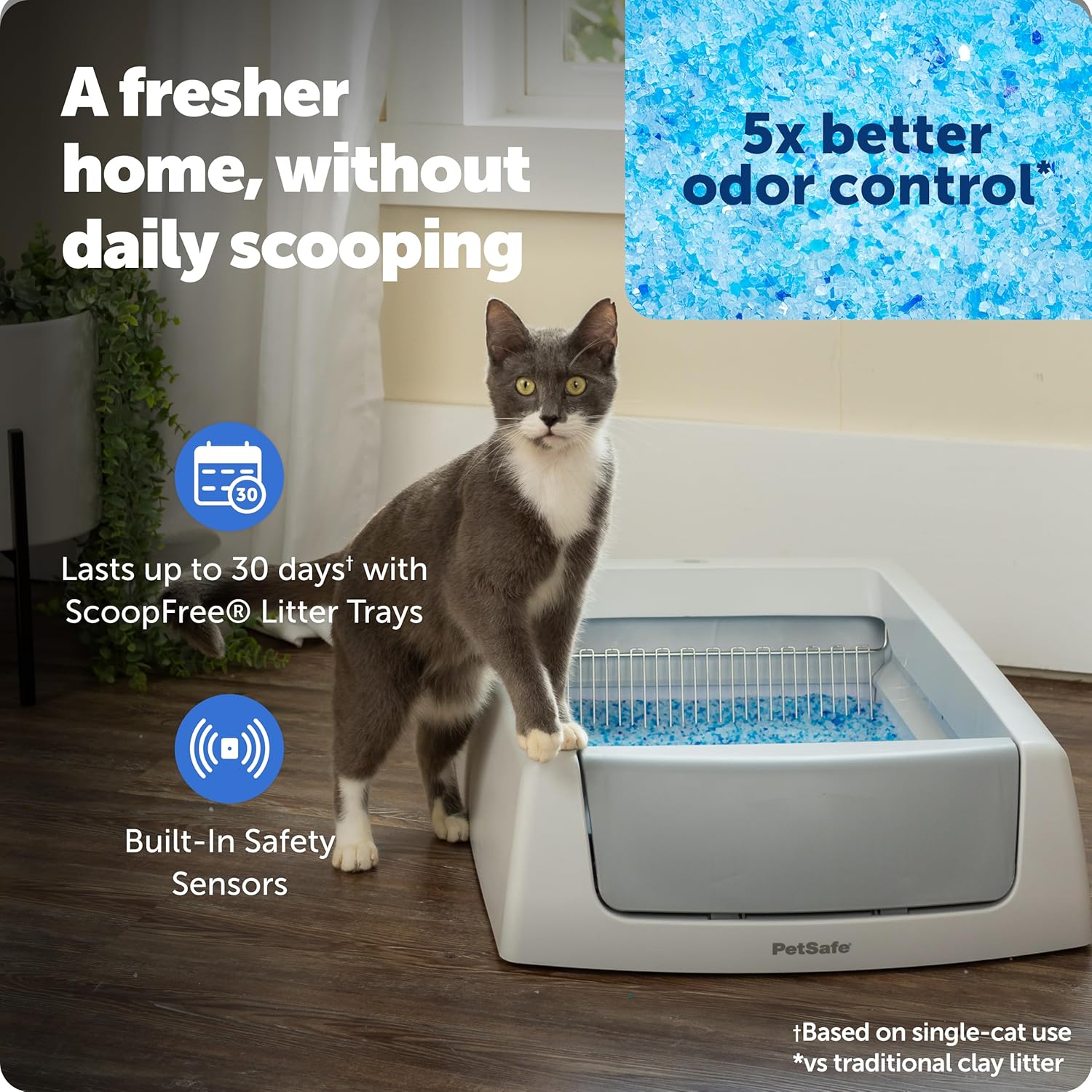
If you’ve ever gotten tired of scooping a litter box — the daily ritual of digging through clumping sand to fish out waste — you’ve probably looked at automatic, self-cleaning litter boxes as a way out. The basic idea is simple: a sensor detects when your cat leaves, a timer counts down, and a rake or rotating mechanism sweeps the waste into a sealed compartment so you don’t have to. PetSafe’s ScoopFree line is one of the most recognizable names in this category, and it’s been around long enough that you’ll find it recommended across dozens of buyer guides. But “ScoopFree” isn’t a single product — it’s a family of models with meaningful differences in how they work, what they cost to run, and how long they’re likely to last. This guide will walk you through each current model, show you the real cost math, and give you a clear answer on which one is worth your money and which one you should walk past.
How ScoopFree Actually Works (and Why Litter Type Matters So Much)
Most automatic litter boxes use clumping clay litter — the same stuff you’d buy in a 40-pound bag at any pet store. ScoopFree takes a different approach: it’s built around silica crystal litter, a lightweight, highly absorbent material that traps moisture and odor without forming a hard clump the way clay does. Instead of a rake scooping clumps into a bin, the ScoopFree rake pushes solid waste into a covered compartment at one end, while liquid waste is simply absorbed by the crystals until the tray is full.
This design choice has real consequences. The upside: silica crystals are genuinely better at odor control over a short cycle than most clumping clay, and the trays stay drier. The downside: you are locked into a proprietary consumable system. PetSafe’s ScoopFree trays — the pre-filled, disposable cartridges that slide into the unit — are the mechanism’s oxygen. You cannot easily substitute a generic litter and expect the rake to function correctly. That tradeoff is the central fact you need to hold onto as you evaluate whether any ScoopFree model makes sense for your household.
The Current Lineup: Model by Model
As of mid-2025, PetSafe offers three primary ScoopFree configurations that are actively sold through major retailers. Here’s how they break down:
ScoopFree Original (Self-Cleaning)
The Original is PetSafe’s entry point — a flat, open tray with a hood-free design, a single rake mechanism, and no connectivity features. It runs on a simple timer: 5, 10, or 20 minutes after your cat exits, the rake sweeps. There’s no app, no weight sensor, no health tracking. It uses the standard blue-crystal disposable trays.
Who it’s for: One-cat households where the owner wants to reduce scooping frequency but isn’t asking the litter box to do much else. It’s the simplest possible version of the ScoopFree concept.
The honest limitation: Reviewers at The Spruce Pets note that open-tray designs consistently underperform on odor control in multi-cat environments — the crystals work, but without a cover, ambient odor escapes between rake cycles. If you have more than one cat, this unit will feel like a compromise within a few weeks.
ScoopFree Ultra (Self-Cleaning with Hood + Health Counter)
The Ultra adds two things the Original lacks: a privacy hood (which meaningfully improves odor containment) and a basic health counter — a display that tracks the number of uses since the last tray change. It is not a smart scale, does not send data to an app, and does not identify individual cats. The counter simply tells you how many visits the tray has logged, which gives you a crude signal for when to swap.
By the numbers:
- ScoopFree Ultra MSRP: ~$129
- Replacement crystal trays (3-pack): ~$45–$55
- Estimated tray lifespan per cat: 20–30 days
- Annual consumable cost (1 cat): ~$180–$240
The Ultra is the model most buyers land on when they’re price-shopping the ScoopFree line, and for a single-cat home, it earns its placement. Apartment Therapy’s roundup of automatic litter boxes points to covered designs as the meaningful upgrade in odor management for smaller living spaces, which validates the hood as a real feature rather than a cosmetic one.
The honest limitation: That health counter is easy to oversell. It counts entries — not weight, not duration, not which cat. In a two-cat household you lose the ability to meaningfully interpret the number almost immediately. If health monitoring is a priority for you, the Ultra’s counter will leave you wanting more within a month.
ScoopFree Smart Self-Cleaning Litter Box (Wi-Fi Connected)
The Smart model is PetSafe’s current flagship and the only ScoopFree unit with app connectivity. It pairs with the PetSafe app via Wi-Fi and adds real-time usage alerts, the ability to adjust the rake delay remotely, and a usage log you can review over time. It does not include a weight scale, so it cannot identify individual cats in a multi-cat home or track weight trends the way a Litter-Robot 4 or PETKIT PURA MAX can.
Who it’s for: Single-cat households where the owner wants remote monitoring and notification — particularly useful for people who travel or work long hours. If you want to know that your cat used the box while you were away, without investing $499–$699 in a Litter-Robot, this is the only ScoopFree option that gets you there.
The honest limitation: The app experience, based on aggregated owner reviews across major retail platforms, gets described as functional but basic. You’re getting push notifications and a usage log — not the kind of health dashboard that produces vet-useful data. Wirecutter’s analysis of the automatic litter box category consistently emphasizes that meaningful health monitoring requires weight-per-visit data, which the Smart model simply doesn’t provide. If that’s the feature you’re trying to buy, you will hit a ceiling quickly.
The Consumable Math: Where the Real Cost Lives
This is the section that most buyer guides skip, and it’s the one that matters most over a two-year horizon.
ScoopFree’s disposable tray system is convenient, but it is a recurring cost that doesn’t appear in the sticker price. Here’s what the math actually looks like:
| Household size | Trays/year (est.) | Annual tray cost (est.) | 2-year cost of ownership (Ultra) |
|---|---|---|---|
| 1 cat | ~15 trays | ~$225 | ~$483 |
| 2 cats | ~24–30 trays | ~$360–$450 | ~$618–$708 |
| 3 cats | ~36–45 trays | ~$540–$675 | ~$798–$933 |
Tray pricing fluctuates, and subscription ordering through PetSafe’s site typically saves 10–15% versus single-order retail. But the pattern is consistent: in a multi-cat household, the consumable cost of a ScoopFree system approaches — and over three years can exceed — the upfront cost of a Litter-Robot 3 Connect, which uses standard clumping litter you can buy anywhere.
PetMD’s guidance on litter management for multi-cat homes recommends one litter box per cat plus one additional as a baseline — a standard most ScoopFree users aren’t meeting with a single unit. That’s worth factoring into your cost projection if you’re currently running one box for multiple cats.
Which Model to Actually Buy (and Which to Skip)
Here’s the decision frame, stated plainly:
Buy the ScoopFree Ultra if: You have one cat, you live in an apartment or smaller space, and your primary goal is reducing daily scooping without spending more than $150 upfront. It’s a legitimate product that does what it claims. The hood earns its keep on odor, the system is low-maintenance, and the tray-swap process is genuinely cleaner than traditional scooping. Reviewers at iHeartCats have consistently rated the covered ScoopFree design well for odor control in single-cat contexts.
Buy the ScoopFree Smart if: You have one cat, you travel or have an irregular schedule, and you want basic remote visibility without committing to a $499+ system. Treat it as a notification tool, not a health monitoring tool, and it will meet your expectations.
Skip the ScoopFree Original: The open tray design is the weaker version of a concept that’s already specialized. The $20–$30 savings over the Ultra is not worth the odor tradeoff. There’s no scenario where the Original is the right answer if the Ultra is available.
Skip the entire ScoopFree lineup if: You have two or more cats, you want individual cat health data (weight trends, visit frequency per cat), or you’re planning to run the system for more than two years and want to minimize consumable spend. In those cases, the consumable math tilts decisively toward a Litter-Robot 3 Connect (which uses standard litter) or a PETKIT PURA MAX, both of which offer genuine health monitoring features the ScoopFree line cannot match.
The 30-Day Return Window: What to Know Before You Commit
Most major retailers — Chewy, Amazon, PetSmart — offer a 30-day return window on automatic litter boxes, which is enough time to do a real cat acclimation trial. The ScoopFree’s open-tray format (on the Original) and relatively low sides can actually work in its favor here: cats that resist enclosed spaces or high-entry boxes often adapt to ScoopFree faster than to globe-style units.
If your cat hasn’t voluntarily used the unit within 14 days, that’s your signal. Per companion animal behavior guidance from Companion Animal Psychology, gradual introduction — placing the unplugged unit next to the existing box, then transitioning litter incrementally — significantly improves adoption rates over cold-swaps. Don’t spend two weeks fighting acclimation and then let the return window close on you.
One practical note: PetSafe’s own warranty is two years on hardware, but it does not cover consumable trays. If you open a tray and your cat refuses to use the unit, those trays are not returnable through most channels. Buy one tray pack before you commit to a subscription.
The Bottom Line
The ScoopFree Ultra is a solid, honest product for a single-cat household that wants to reduce daily litter maintenance without overthinking it. The Smart model adds useful remote visibility for the right use case. The Original isn’t worth choosing, and the entire lineup has a ceiling that multi-cat owners will hit faster than the marketing implies.
If X is a single-cat home with a sub-$200 budget and no appetite for app complexity, the Ultra is your answer. If X is two or more cats, or you want health data your vet can act on, skip the ScoopFree line entirely and start your evaluation at the PETKIT PURA MAX or Litter-Robot 3 Connect — the consumable math and feature set both point that direction over any meaningful ownership horizon.