August 10, 2026 • Margot Vellacourt • 10 min reading time • Prices verified June 4, 2026
The Self-Cleaning Litter Box Long-Term Test: What Owners Report After 6–12 Months
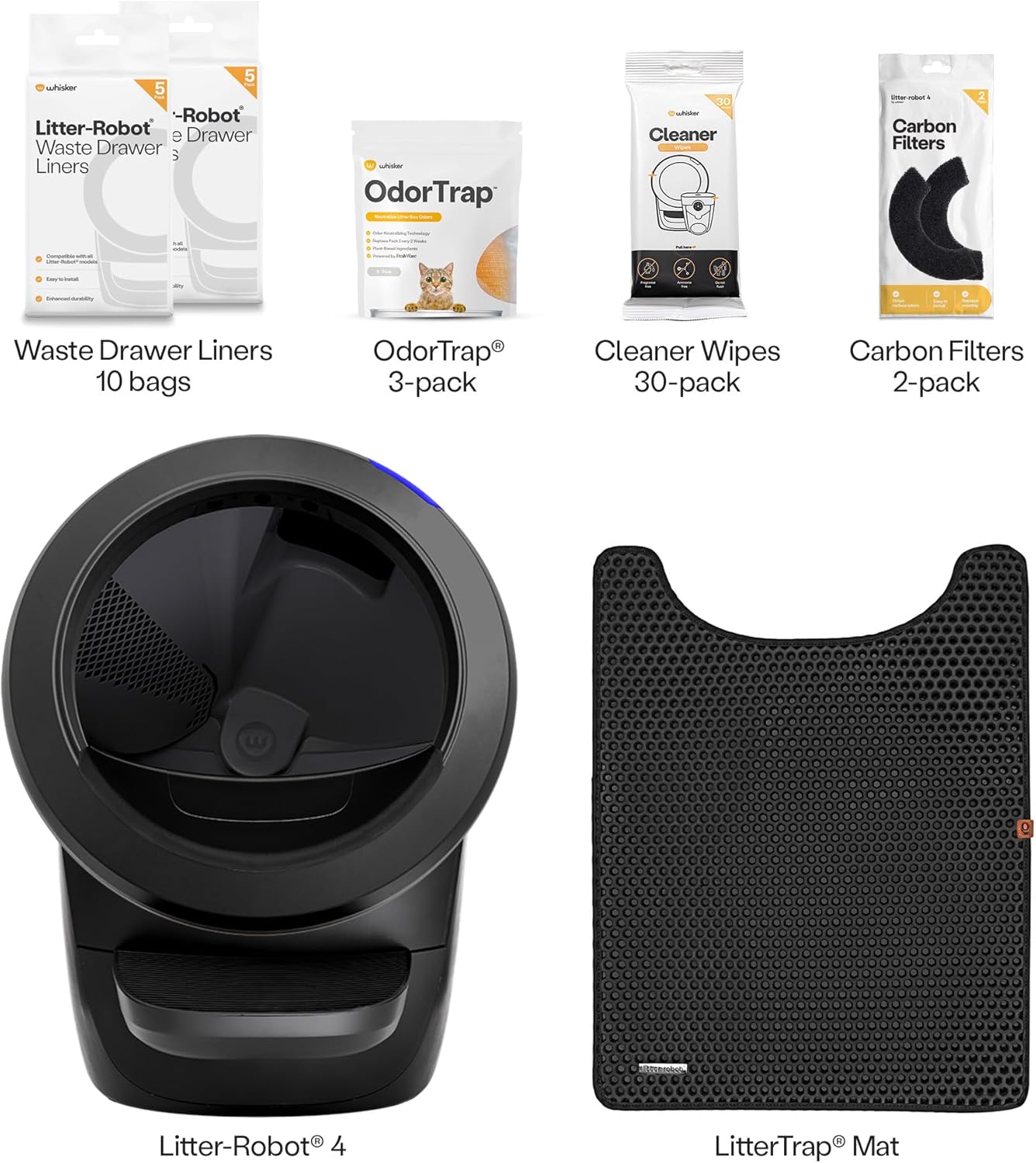
If you’ve ever looked at a self-cleaning litter box — the kind that scoops, rotates, or rakes itself so you don’t have to — and wondered whether it actually holds up past the honeymoon period, you’re in the right place. A self-cleaning litter box is any automated unit that detects when a cat has used it and removes waste on its own, depositing clumps or crystals into a sealed drawer or bag. The appeal is obvious: less daily scooping, better odor control, and (on premium models) app-based tracking of your cat’s bathroom habits. But the sticker price is only the beginning of the story. The real question — the one that only surfaces after six months of daily use — is which machines are still running reliably, and which are sitting on a curb.
This article synthesizes long-term owner feedback across the price spectrum, from sub-$150 budget units up through the Litter-Robot 4. If you’re mid-decision or already own a unit and are watching it age, this is the data you couldn’t get from an unboxing review.
The Reliability Divide: Budget Units vs. Premium Builds
The most consistent pattern across aggregated long-term reviews is a stark reliability split somewhere around the $200 price threshold. Budget units — roughly anything under $150 at launch — show failure rates that reviewers describe in strikingly similar language: motors that stop responding, sensors that trigger constantly or not at all, and plastic housings that crack or warp within weeks.
The oneisall self-cleaning box is the clearest cautionary data point in the current owner-report corpus. Multiple owners describe units dying within one to two weeks of purchase. One owner documented buying a second replacement unit of the same model — which also failed. That’s not a single defective batch; that’s a design and manufacturing pattern. iHeartCats’ buyer’s guide on self-cleaning litter boxes flags early motor failure as the most common complaint category for sub-$150 units, and the oneisall pattern fits that profile exactly.
The CATLINK Open-X adds a different kind of failure story. One reviewer explicitly described disposing of the unit after roughly ten weeks — not because the motor died, but because of bin construction problems and setup confusion that made the unit functionally unusable. That’s a meaningful distinction: it’s not always a mechanical failure that ends a budget unit’s life. Sometimes it’s an ergonomic design choice that compounds over weeks until the owner gives up. Wirecutter’s updated 2025 self-cleaning litter box roundup notes that setup complexity and ambiguous error states are underreported friction points that only surface well after purchase.
The PetSafe SmartSpin lands in a middle category. It’s not a quick death, but long-term owners flag a specific design flaw: the rubber base that traps litter becomes sticky with sustained use, creating a maintenance problem that gets progressively worse. That’s the kind of issue that doesn’t appear in a two-week trial and doesn’t make it into most first-impression reviews.
The practitioner takeaway: If a unit has reviews describing failure within 30 days, treat it as disqualified regardless of price. The question isn’t whether the unit works on day one — it’s whether the design has any mechanical buffer against daily wear across 1,500-plus cycles per year.
The Repurchase Signal: The Most Honest Long-Term Metric
The single most reliable long-term satisfaction signal in the owner-report data isn’t star rating — it’s repurchase behavior. When an owner buys a second unit of the same brand, that’s a decision made with full information. They knew the tradeoffs, they experienced the failure modes, and they chose to re-enter the same ecosystem.
In the current data set, the brands and models generating consistent repurchase behavior include UPFAS, PetPivot, Petcove, and — most prominently — the Litter-Robot 4. The Litter-Robot repurchase pattern is especially notable because it happens at a $699 price point. Owners expanding from one unit to two or three aren’t making that decision lightly.
One particularly useful data point: owners with six cats who describe full household conversion to Litter-Robot 4 within 2.5 months, with zero reported regret at the six-month mark. That’s a stress-test scenario — six cats generate roughly 18 to 24 litter box visits per day across a full fleet, and the units are processing that volume without reported mechanical issues. The Spruce Pets’ long-term evaluation notes that the Litter-Robot’s build quality is specifically designed for multi-cat households, with the globe mechanism rated for continuous heavy use in a way that single-cat-targeted units are not.
The Cumrige self-cleaning box offers a different kind of repurchase signal. One owner who migrated from a dead Litter-Robot to the Cumrige specifically notes ongoing satisfaction after several months at a fraction of the cost. That’s useful data: it means there’s a genuine mid-tier option that isn’t just “Litter-Robot for less money” but is actually delivering durable performance for owners who can’t justify the flagship price.
ScoopFree Crystal Economics: The Tray Cost Math You Need to Run
The ScoopFree product line — specifically the ScoopFree Crystal Pro and ScoopFree Crystal Classic — generates some of the most durable long-term satisfaction data in the sub-$200 category. Multiple owners report four years of reliable use on the Crystal Pro; three years of consistent performance on the Crystal Classic, with one owner specifically noting Black Friday pricing as the reason the economics worked for them.
But both sets of long-term owners flag the same primary friction point: tray replacement cost. The ScoopFree system uses disposable crystal litter trays rather than bulk litter — you swap the whole tray when it’s spent. Under normal single-cat conditions, a tray lasts roughly 20 to 30 days. Under multi-cat conditions, or with a diabetic cat (who urinates significantly more frequently than a healthy cat), tray lifespan compresses dramatically.
By the numbers — ScoopFree tray cost modeling:
| Scenario | Tray lifespan | Annual tray cost (est.) |
|---|---|---|
| 1 healthy cat | ~25 days | ~$175–$215/yr |
| 2 cats | ~12–15 days | ~$290–$360/yr |
| 1 diabetic cat | ~10–14 days | ~$320–$430/yr |
These estimates are consistent with owner-reported consumption rates aggregated across long-term reviews. PetMD’s guidance on litter box hygiene for diabetic cats notes that increased urination is a defining management challenge, and any system relying on fixed-capacity disposable trays will feel that pressure acutely.
If you have more than one cat, or a cat with a metabolic condition, the ScoopFree’s consumable model deserves a full five-year cost projection before purchase — not just a sticker-price comparison. The machine itself may last four years. Whether the tray economics make sense across that window is a separate calculation.
The practitioner decision rule: ScoopFree Crystal systems are a genuine long-term buy for single-cat households where the owner values simplicity over consumable cost optimization. For two-plus cats, or any cat with elevated urination, run the tray math first. The hardware reliability is there; the economics may not be.
Early Warning Signs and Globe-Style Error Codes
One of the most common questions in owner communities is whether an over-torque error on a globe-style unit — like the Litter-Robot — means the machine is dying or just needs maintenance. The short answer, based on aggregated long-term owner reports, is: it’s almost always maintenance, not mortality.
Globe-style units (units where a rotating sphere separates clumps from clean litter into a waste drawer below) generate over-torque errors when the motor encounters resistance it can’t clear in a normal cycle. The causes, in order of frequency reported by long-term owners:
- Litter level too high. Overfilling is the most common trigger. The globe needs clearance to rotate; excess litter creates drag that reads as mechanical resistance.
- Litter clumping on the globe interior. Certain litter formulations — particularly clay litters that clump aggressively — leave residue on the globe wall that builds up across cycles.
- Waste drawer not fully seated. The drawer interlock triggers a fault if the drawer isn’t fully closed, which can present as a torque error on some firmware versions.
- Actual motor wear. This is the least common cause and typically appears only after multiple years of heavy use — not within the first 12 months under normal conditions.
Modern Cat’s 2024 analysis of high-tech litter box ownership notes that most Litter-Robot over-torque errors resolve with the reset sequence outlined in Whisker’s own support documentation, and that owners who contact Whisker support directly report high resolution rates without hardware replacement. If your unit is under 18 months old and throwing torque errors, exhaust the maintenance checklist before assuming hardware failure.
More broadly, the early warning signs that a self-cleaning box is approaching end-of-life include: cycle timing that becomes inconsistent (running longer or shorter than the programmed delay), partial rotations that don’t complete, waste drawer sensors that misfire, and — on app-connected units — weight readings that drift away from calibration without a firmware-explainable cause. Apartment Therapy’s 2025 guide to automatic litter boxes for small spaces notes that app connectivity is actually useful here, because owners with connected units catch these drift patterns weeks earlier than owners relying on visual inspection alone.
Frequently Asked Questions
How long do budget self-cleaning litter boxes actually last before breaking?
Owner data is consistent: units under $150 show a meaningful failure cluster in the first 30 to 90 days, with a second cluster around the 6-month mark as motors approach their design limits under daily cycling. The oneisall pattern — two consecutive units failing within two weeks — represents the worst end of this range. Units in the $150–$200 band, like the PETKIT PURA X, show better durability, but the data thins out past 18 months because the category turns over quickly. If a sub-$150 unit survives 90 days without error states, it has cleared its highest-risk window.
What is the real tray replacement cost for ScoopFree systems with multiple cats or a diabetic cat?
See the table in the ScoopFree section above. The short version: single-cat households pay roughly $175–$215 per year in trays. Two-cat households pay $290–$360. A diabetic cat, whose elevated urination loads the tray faster, can push annual tray cost above $430 depending on intake volume. These figures are consistent with owner-reported consumption across long-term reviews.
Which self-cleaning boxes do owners actually buy a second time?
The clearest repurchase signals in the current data come from Litter-Robot 4, UPFAS, PetPivot, and Petcove owners. The Litter-Robot 4 repurchase pattern is strongest because it happens at a premium price point — owners choosing to add a second unit at $699 are making an informed decision. The Cumrige also appears as a repurchase unit for owners migrating from failed higher-end units who want proven durability at a lower price point.
What are the early warning signs that a self-cleaning box is about to fail?
Watch for: inconsistent cycle timing, partial rotations that don’t complete, waste drawer sensor misfires, and weight readings that drift on app-connected units. Any of these emerging within the first six months is a red flag. Emerging after two-plus years of heavy use is expected wear.
Do over-torque errors on globe-style units mean the machine is dying or just needs maintenance?
Almost always maintenance. Check litter level, litter residue on the globe interior, and waste drawer seating before assuming hardware failure. Whisker’s support documentation covers the reset sequence; long-term owners report high resolution rates without part replacement when errors appear in the first 18 months of ownership.