August 19, 2026 • Margot Vellacourt • 9 min reading time • Prices verified June 4, 2026
Which Sub-$200 Self-Cleaning Litter Boxes Actually Survive 12 Months
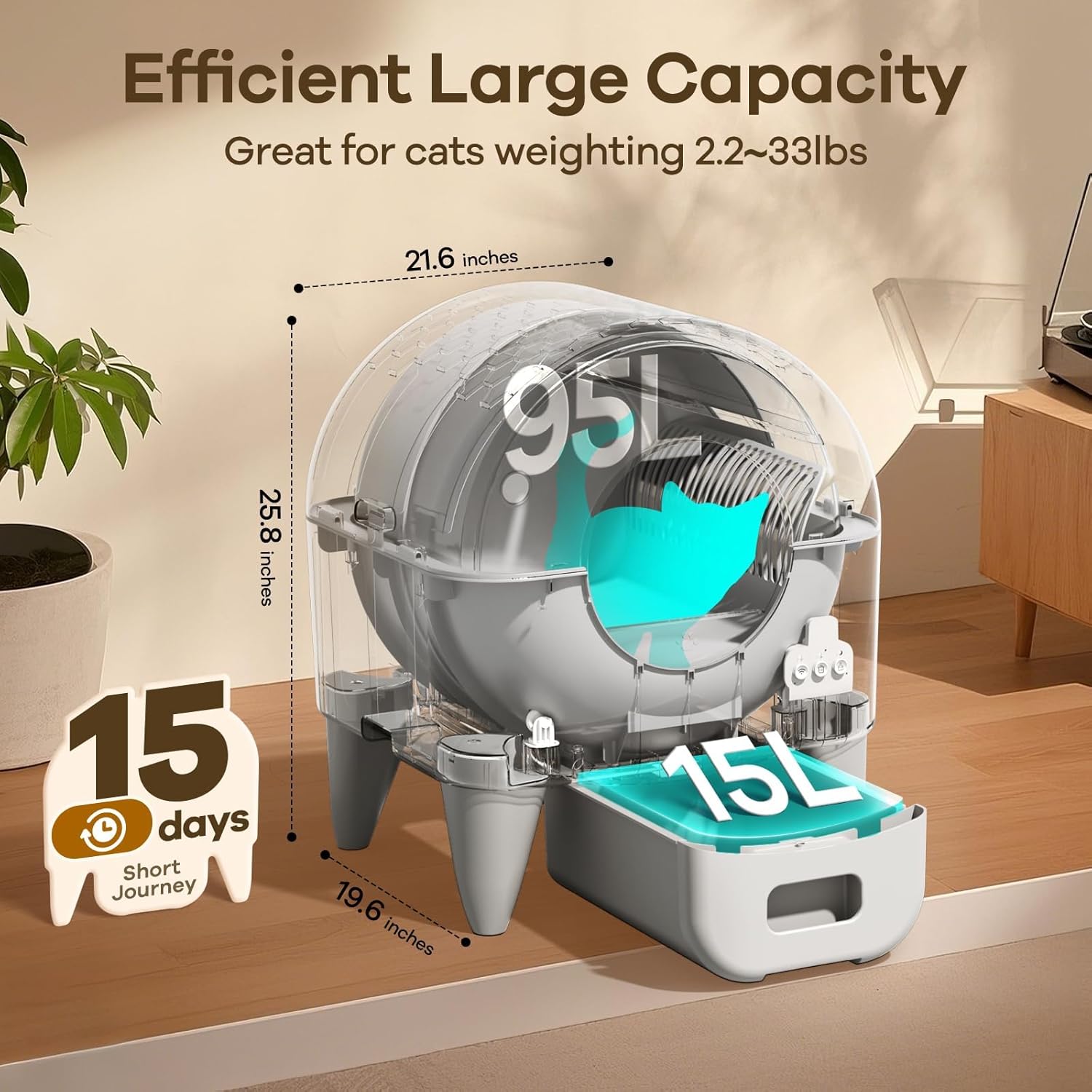
If you’re new to the idea of a self-cleaning litter box, here’s the short version: instead of scooping waste by hand every day, these machines detect when your cat has finished using the box and automatically rake, rotate, or sift the clumps into a sealed drawer or bag. It sounds like a small luxury, but for anyone managing two or more cats — or just tired of the daily ritual — it changes the math significantly. The catch is that the $150–$200 price range is genuinely uneven. Some units are thoughtfully engineered and still running strong after a year of daily use. Others strip their gears, jam their sensors, or get abandoned in closets within three months. This guide is built to tell you exactly which is which — before you spend the money.
The Real Question Isn’t Price: It’s Design Lineage
Here’s the framing that matters when you’re evaluating the sub-$200 field: most of these units share a small number of underlying mechanical architectures. You’ll see rotating globes (a sealed sphere that tumbles waste to a collection drawer), raking arms (a tine-based mechanism that combs through the litter bed), and conveyor or sifting trays (which agitate or vibrate litter through a screen). Each architecture has a characteristic failure mode, and the price tag doesn’t tell you which one you’re getting.
Raking arms are the most common mechanism in the sub-$200 tier. The rake travels horizontally across the litter bed, pushing clumps into a hopper or enclosed tray. The failure mode owners consistently report — across hundreds of aggregated reviews on The Spruce Pets and Apartment Therapy — is motor burnout combined with rake jamming. Heavy clumps, litter grain size mismatches, and large cats who dig aggressively all compound stress on a small DC motor that was specified at the lowest viable cost point. Units that don’t have an automatic jam-reversal feature (where the motor reverses direction when resistance spikes) tend to strip gears or burn out within six to nine months under daily two-cat use.
Rotating globes are rarer in this price band — the Litter-Robot’s globe design sits at $499–$699 — but a small number of competitors attempt a globe-adjacent design closer to $200. The mechanical complexity of a globe mechanism at this price point tends to compress the longevity window. The bearings that allow the globe to rotate without wobbling are expensive to machine precisely; cheaper alternatives introduce vibration that, over time, cracks the waste receptacle housing.
Self-raking crystal trays — most famously the PetSafe ScoopFree design, which uses silica gel crystals rather than conventional clumping clay — sidestep the clump-and-jam problem entirely, because the mechanism is simpler: a rake moves once per cycle across a bed of crystals that absorb liquid rather than forming clumps. Reviewers at The Spruce Pets consistently identify this as the most mechanically durable architecture in the sub-$200 range. The tradeoff is recurring consumable cost, which we’ll get to.
The Contenders: What the Evidence Actually Shows
PetSafe ScoopFree Ultra — ~$129
The ScoopFree Ultra is the most-cited “reliable budget option” across editorial sources including Wirecutter and Apartment Therapy. The rake mechanism is genuinely simple — there are very few moving parts — and owners in long-run reviews note that motor failure in the first 12 months is uncommon when the unit is used with the manufacturer-specified silica crystal trays (not third-party substitutes).
The durability story here is honest but conditional: the machine itself tends to survive. The system cost is another matter. ScoopFree trays — pre-filled, disposable — run approximately $20–$25 per tray, and for a single cat PetMD’s litter-box hygiene guidance suggests tray replacement every 20–30 days. Two cats compresses that to 10–15 days per tray. At the high end of two-cat use, you’re looking at roughly $600–$700 in consumable tray costs over 12 months. The $129 hardware is, in practice, an entry point to an ongoing subscription cost the sticker price doesn’t telegraph.
Best for: Single-cat households, or multi-cat owners who switch to refillable tray alternatives (several third-party options exist, though they void the warranty).
Skip if: You have two or more large cats with high usage frequency. The consumable math stops being competitive against units that accept bulk clumping litter.
PETKIT PURA MAX — ~$169
The PETKIT PURA MAX is the most feature-rich unit in the sub-$200 tier as of mid-2026, and it’s genuinely interesting because it punches significantly above its price point on paper: it includes app connectivity, weight-based cat detection, and odor-sealing lid closure. The Spruce Pets notes it in the same breath as units twice its price in terms of stated features.
But the durability picture is more complicated than the spec sheet. Owners in aggregated reviews consistently flag two patterns: (1) the app-connected motor cycles can be fussy about litter fill levels — overfill by more than a centimeter and the rotation sensor logs false positives, which over-cycles the motor; (2) the globe-adjacent rotation mechanism, while not a true globe, uses a drum rotation that places significant stress on the drive belt. Long-run owners (12+ months) report drive belt replacement as a recurring maintenance item. PETKIT does sell replacement belts, but the process requires partial disassembly.
That said: for owners who stay within the manufacturer’s recommended litter type and fill range, the failure rate narrative is considerably better. Apartment Therapy reviewers describe the PURA MAX as “impressively durable for the price” when used as specified.
Best for: Tech-forward buyers who want app-based visit logging and don’t mind doing minor maintenance. Strong choice for the first-time buyer who wants to try health monitoring features without the Litter-Robot 4 commitment.
Skip if: You’re managing three or more cats with heavy daily use. The motor and drive belt stress compounds quickly in high-cycle environments.
Generic/OEM Raking Units ($80–$140)
There is an entire ecosystem of visually similar raking units — sold under rotating brand names, often manufactured from the same factory tooling — that populate Amazon and big-box retail in the $80–$140 range. Wirecutter’s analysis of the budget automatic litter box category notes explicitly that this tier is characterized by high failure rates, inconsistent motor quality, and replacement-part unavailability.
The tell: if you cannot find model-specific replacement parts listed on the manufacturer’s own website (not just Amazon), the unit was not designed for longevity. Manufacturers who expect their hardware to survive 12+ months offer documented part replacement paths. Those who don’t are pricing the machine as a consumable.
Our recommendation: skip this tier entirely. The $80 savings over the ScoopFree Ultra do not offset the probability of hardware failure within six months, the absence of any meaningful warranty support, and the environmental cost of a unit destined for landfill.
By the Numbers
| Unit | Sticker Price | Est. 12-Mo. Consumable Cost (2 cats) | Est. Total Year-1 Cost |
|---|---|---|---|
| PetSafe ScoopFree Ultra | $129 | ~$600–700 (disposable trays) | ~$730–830 |
| PETKIT PURA MAX | $169 | ~$80–120 (bulk clumping litter) | ~$250–290 |
| Generic OEM rakers | $80–140 | ~$60–80 (litter) + replacement unit likely | ~$220–360+ |
| Litter-Robot 3 Connect (for reference) | $499 | ~$80–120 (bulk litter) | ~$580–620 |
Consumable estimates based on manufacturer-recommended replacement cadences and mid-2026 retail pricing for litter and tray refills.
The table above clarifies something the sub-$200 sticker price reliably obscures: the PETKIT PURA MAX — if it survives 12 months intact — is actually the lowest total-cost option in this tier for multi-cat clumping-litter households. The ScoopFree Ultra’s disposable tray architecture creates a consumable burden that rivals the cost of owning a Litter-Robot 3 Connect over the same period.
The 30-Day Return Window: How to Use It as a Diagnostic
This deserves its own section because it’s the practical move most buyers don’t make. Nearly every retailer selling these units — PetSafe directly, Chewy, Amazon, Target — offers a 30-day return window. For a sub-$200 automatic litter box, the 30-day window is not just consumer protection. It’s a controlled durability trial.
Here’s the specific pattern to watch for in the first 30 days:
-
Motor noise baseline. Run the unit the first day and note the sound. Any grinding, clicking, or irregular cadence in the first week of use — with fresh litter at the correct fill line — is a forward-pointing failure signal, not a break-in artifact.
-
Sensor reliability. Does the unit consistently detect your cat’s entry and exit before initiating a cleaning cycle? False-positive cycling (the machine running when no cat is present) and false-negative cycling (the machine not running after use) both indicate sensor drift that tends to worsen, not stabilize.
-
Jam frequency. A well-specced raking unit should complete 30 days of normal use with zero jams when operated with the correct litter type at the correct fill level. Any jam in the first 30 days under those conditions is a warranty claim, not a user error.
If any of these signals appear, return the unit before Day 30. Don’t rationalize. The failure mode you’re seeing in Week 2 will be a dead motor by Month 7.
The Decision Rule
If you’re a single-cat household who prioritizes mechanical simplicity and doesn’t mind a consumable tray model, the PetSafe ScoopFree Ultra is the most defensible choice. Its mechanical durability record is the clearest in this tier. Budget for the tray costs honestly before you buy.
If you’re a multi-cat household (two cats, average usage frequency, clumping litter preference) and you want app connectivity and health visit logging, the PETKIT PURA MAX is the better bet — provided you’re comfortable doing minor maintenance if the drive belt shows wear at the 9–12 month mark. The total cost-of-ownership math over 12 months is genuinely competitive, and the feature set gives you a meaningful preview of the premium-tier experience before committing to $499+.
If you are looking at any generic OEM raking unit under $140 because it looks similar to the PETKIT on the listing page: don’t. The visual similarity is intentional and the internals are not comparable. The money you save on hardware you will spend on replacement hardware within a year, and you’ll have contributed a largely un-recyclable plastic unit to landfill in the process.
The sub-$200 tier has two genuinely survivable options and one category to avoid entirely. The math is clear enough that the decision, once you know the failure modes, mostly makes itself.