July 3, 2026 • Margot Vellacourt • 11 min reading time • Prices verified June 4, 2026
Tofu and Mixed Plant Litter in Automatic Boxes: Flushable, Low-Tracking, but Not for Every Machine
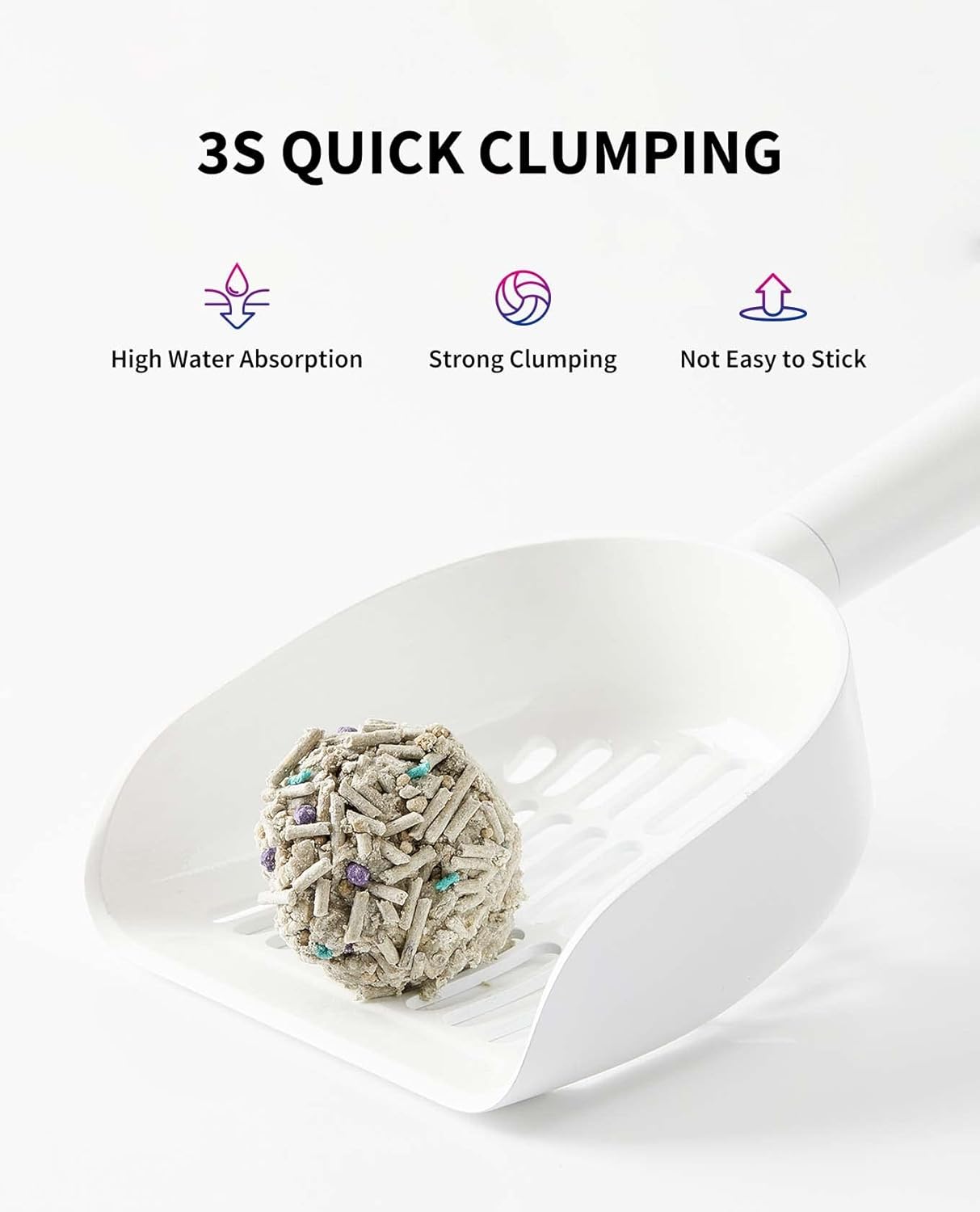
If you’ve ever watched your cat track a fine white powder trail across your apartment floor after visiting their litter box, you’ve already met the core problem that tofu litter tries to solve. Tofu litter — made from compressed soybean pulp, sometimes blended with corn starch, bamboo fiber, or activated charcoal — is a category of plant-based cat litter that clumps on contact with moisture, produces very little dust, and, in certain formulations, can be flushed down a standard toilet in small quantities. It sits at the intersection of two trends: the broader shift toward biodegradable, lower-guilt consumables, and the rise of app-connected automatic litter boxes that have their own strong opinions about what you put inside them. This article is a compatibility map. If you’re running or seriously considering a self-cleaning machine and wondering whether plant-based litter is a straight upgrade from clay, the short answer is: sometimes yes, sometimes it trips sensors, and one machine’s owners consistently say it performs better than clay — but another machine’s geometry defeats even the best clumping litter regardless of what you fill it with.
What Makes Plant-Based Litter Different — and Why Machines Care
Clay litter — specifically sodium bentonite, the clumping variety — has been the reference standard for self-cleaning boxes because it behaves predictably: it clumps fast, clumps hard, and doesn’t compress under the weight of a rake or a rotating globe. Its liabilities are well-documented. It’s strip-mined, it’s heavy, and the silica dust it releases is a known respiratory irritant for both cats and owners — something that Naturally Fresh walnut litter owners cite frequently as a reason they switched, with some reviewers specifically framing it as a health decision rather than a convenience one. The values-based buyer is real in this category, not a niche edge case.
Tofu and mixed plant litters clump differently. The pellets or granules absorb moisture and bind to each other via a softer mechanism — more like a gel than a hard brick. The clumps are typically lighter, slightly more porous, and more prone to partial breakdown under aggressive mechanical action. That last characteristic is exactly where the machine compatibility story gets complicated.
Self-cleaning boxes fall into three mechanical types, and each type interacts with soft clumps differently:
Rotating globe mechanisms (Litter-Robot 3 Connect, Litter-Robot 4) sift by turning the entire globe upside down — waste falls through a screen into a drawer below, clean litter stays inside. The sifting action is gentler on clumps than a rake but depends on clumps being firm enough not to crumble through the screen.
Raking mechanisms (many sub-$200 units, some PETKIT models in earlier generations) drag a toothed comb through the litter bed. Softer clumps risk partial fragmentation, which redeposits litter waste into the clean bed.
Sifting-bucket and rotating-drum mechanisms (Popur X5, PETKIT PURA MAX) use a different geometry again — some rotate horizontally, others tilt and sieve. These tend to be more forgiving of lighter, softer clumps.
This mechanical taxonomy matters because owner reports on tofu litter compatibility break cleanly along these lines.
Machine-Specific Compatibility: What Owners Actually Report
The most concrete compatibility data point in this category comes from owners who have run PETKIT Clump+ tofu litter specifically in a Litter-Robot 5. The pattern in aggregated reviews is striking: multiple owners describe it as performing better than clay in that machine — producing cleaner separation of waste from the litter bed, less carryover of small fines into the waste drawer, and noticeably less dust accumulation inside the globe. For owners who have been frustrated by the Litter-Robot’s tendency to pass very fine clay particles through the screen over time, this is a meaningful practical upgrade.
The Popur X5 compatibility story is equally strong. Reviewers testing PETKIT Clump+ in the Popur X5 report essentially zero tracking at the box’s exit — which is notable because the Popur X5 has a step-out design that typically does a reasonable job regardless of litter type. When you get zero-tracking reports with a specific litter, that pairing is worth noting.
The Litter-Robot 3 Connect and Litter-Robot 4 are more nuanced. Owners running standard tofu litter (not the Clump+ formulation) report that compatibility varies by brand density. Lighter, coarser pellets can work well; finer-grain tofu blends sometimes produce sensor errors — more on that in the FAQ section — and very soft clumps occasionally break apart during the globe’s rotation and fall back into the clean litter bed partially intact. The consensus from the Litter-Robot community is: if you want to run tofu litter in a Litter-Robot 3 or 4, start with a denser, pellet-style formulation and monitor the waste drawer for crumbled clump residue in the first two weeks.
One finding that applies regardless of machine type: PETKIT’s own standard Tofu litter has reviews flagging it as optimized for PETKIT’s own automatic mechanisms. Owners who tried it in traditional manual boxes reported excessive tracking — which is an unusual complaint for a product category marketed partly on low-tracking credentials. The implication is meaningful: some plant-based litters may be engineered with specific mechanism geometries in mind, not as universal-fit products. Buying tofu litter because you read that “plant-based litter has low tracking” and then running it in a machine it wasn’t designed around can produce worse results than continuing with clay.
The harder failure mode comes from open-top rake designs — a common architecture in many sub-$200 units. One recurring pattern in reviews of the Mintakawa and similar rake-design boxes is a persistent sticky accumulation point in the mechanism where litter clumps regardless of litter type. Reviewers describe this as a geometry problem: the rake’s path and the box’s corners create a dead zone where soft clumps, unable to clear the mechanism, build up and eventually harden. This isn’t a tofu litter problem specifically — it happens with clay in those same machines — but tofu’s softer clumps are more likely to smear into that dead zone than to sit there as a discrete brick that’s easy to remove. If you’re evaluating a sub-$200 rake-design box, this is an argument for testing litter compatibility before committing to a plant-based switch.
The Flush Question: What “Flushable” Actually Means
Most plant-based tofu litters carry “flushable” on their packaging, and the underlying chemistry does support it: soy and corn starch materials dissolve in water far faster than clay, which never dissolves at all. But “flushable by the litter’s chemistry” and “safe to flush in your specific plumbing” are two different claims.
PetMD’s editorial on flushable cat litter (2024) draws a clear line here: the chemistry of dissolution is only one variable. Older cast-iron or clay-tile drain lines — common in apartments and homes built before 1970 — have rougher interior surfaces where even dissolved material can catch and accumulate. More significantly, cat feces can carry Toxoplasma gondii, a parasite that standard municipal wastewater treatment is not reliably designed to filter out before water re-enters watersheds. California has explicitly advised against flushing cat waste into municipal systems for this reason, and that advisory applies regardless of litter type.
The practical rule most informed owners follow: flush the litter itself (not the waste) only in small quantities, only if your plumbing is newer and high-flow, and never flush litter clumps that contain feces. The “flushability” benefit is real but narrower than the packaging implies.
The True Cost Comparison: Tofu vs. Premium Clay
The per-bag price of tofu litter looks higher than clay at first glance. The math changes when you account for consumption rate.
A rough monthly cost comparison for a two-cat household:
| Litter type | Avg. monthly consumption | Approx. monthly spend (2026 pricing) |
|---|---|---|
| Premium clumping clay (e.g., Dr. Elsey’s) | ~28 lbs | $22–$28 |
| Tofu / plant-based pellet | ~8–10 lbs | $20–$26 |
| Mixed tofu + silica blend | ~7–9 lbs | $23–$29 |
The consumption rate difference is real: plant-based litters are lighter per volume and tend to require less total replenishment per cycle because the clumps don’t shatter into fine unusable residue the way clay can. Modern Cat’s natural litter roundup (2025) notes that owners consistently report stretching tofu litter further per bag than equivalent premium clay — though the margin narrows in high-use multi-cat households where the litter bed works harder. At three or more cats, plan for the higher end of the consumption range above, and rerun the math before assuming tofu is definitively cheaper.
Frequently Asked Questions
Is tofu or plant-based litter actually compatible with my Litter-Robot 3, 4, or 5? For the Litter-Robot 5, owner reports are consistently positive with PETKIT Clump+. For the 3 and 4, the answer is “probably yes, with the right formulation” — go for denser pellet-style tofu rather than fine-grain, and give it a two-week monitoring window. Soft or crumbly formulations risk partial clump breakdown during globe rotation.
Can I flush plant-based litter down a standard household toilet safely? The litter itself (without waste) can be flushed in small quantities if your plumbing is modern and high-flow. Do not flush cat feces through any toilet system; the parasite risk to waterways is real and California’s water authority guidance on this is explicit.
Why does my automatic box throw sensor errors after I switched to tofu litter? Most self-cleaning boxes use weight sensors or infrared sensors to detect cat presence and waste-drawer fill levels. Tofu litter is lighter than clay, so the initial weight reading may not calibrate correctly — the box may interpret the lighter litter load as an incomplete fill or a sensor fault. Fix: fill to the manufacturer’s recommended depth marker by volume, not by weight, and allow 2–3 cycles for the machine to recalibrate. Some units require a manual reset after a litter-type change.
Does plant-based litter clump as reliably as clay in high-use multi-cat households? For two cats: yes, and reviewers consistently rate the PETKIT Clump+ formulation as fast and firm. For three or more cats with a single box running 12+ cycles per day, clump integrity under heavy mechanical load is less well-documented. The Spruce Pets’ automatic litter box guide recommends one box per cat plus one as baseline — at that ratio, no single box is working hard enough for clump integrity to degrade under normal plant-based litter.
What does the pH indicator in PETKIT Tofu litter actually tell me, and can I trust it? PETKIT’s pH-sensitive tofu litter changes color when urine pH falls outside a normal range, flagging a potential urinary health issue. It’s a directional signal, not a diagnostic tool — color changes can reflect dietary variation, hydration level, or timing of the sample as much as pathology. Apartment Therapy’s low-tracking litter guide (2025) notes that owners find the indicator useful as an “alert to call the vet,” not as a replacement for a urinalysis. Trust it as a trigger for professional follow-up, not as a standalone health reading.
Is the per-month cost of tofu litter genuinely lower than premium clay once consumption rates are accounted for? For one to two cats: modestly yes, when you account for the lower consumption rate by weight. For three or more cats: the margin is thin enough that it’s worth tracking your actual monthly bag usage for 60 days before concluding either way. The cost parity case is stronger than the “tofu is much cheaper” marketing claim, but it’s real.
The Decision Rule
If you’re running a Litter-Robot 5 or a Popur X5, the owner evidence for plant-based litter — specifically PETKIT Clump+ — is strong enough to justify a trial bag. The tracking and clump-separation improvements owners report are concrete and consistent.
If you’re on a Litter-Robot 3 or 4, try a pellet-style tofu formulation and give it three weeks before judging. Watch for sensor errors and inspect the waste drawer for crumbled clump residue after each cycle.
If you’re on a sub-$200 rake-design box, solve any mechanical dead-zone issues in your machine first. Tofu litter won’t fix a geometry problem, and its softer clumps may make that problem more visible. The litter-switch conversation comes after the machine works correctly with clay.
If low dust and reduced environmental guilt are driving the switch — both legitimate motivations that owner communities take seriously — the functional case for plant-based litter in a compatible machine is genuinely solid. Just match the litter to the mechanism, not to the marketing copy on the bag.